Rabu, 22 Februari 2006

NIEDERHOFFER AND THE MARKETS

Via a book review on the site of Tradermike I came across the name of Victor Niederhoffer. Known in the eighties and nineties as one of the most succesfull traders on Wall Street but broke twice as is described by Malcolm Gladwell. He maintains a very interesting weblog about the markets with subjects concentrating on statistics, probabilities and failure.


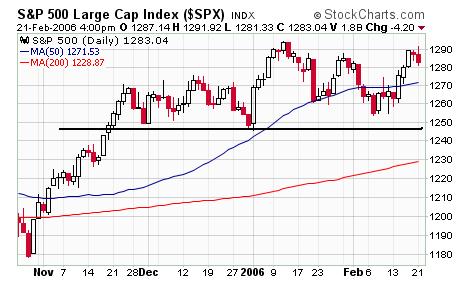
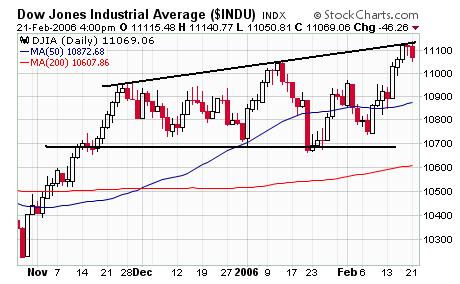
Markets in a consolidation phase, not much to say about it. The Dow Jones moving slightly above its tradingrange and the S&P 500 in a narrowing range:


Senin, 20 Februari 2006

TIME FILTER

One of the things concerning me at the moment as a trader is the question if I should take all the tradesetups my system gives. I trade in a very distinctive timeframe: I only trade during the day and don't take positions overnight, so setups that occur after a certain hour I don't take.


The question is not a question about looking for an indicator filter. It is merely a point do I take another trade if my first trades were winners? Why take another another risk? Systemtically you should take the trade but is it worth the risk?


I am not a mathematician but suppose the system produces 10000 trades. You tested it with Monte Carlo or otherwise and it should give a nice profit. But wouldn't you expect that a random part of these trades, say 1000 trades, produce the same result?
I would think so.


But what if I sample all these 10000 trades in series which are determined by timeframes, say weeks or days. Would the result of such a sample serie, in the long run be the same as any other? That's the question I ask because if yes, this would mean that in any chosen timeframe it would be more profitable to stop after a winner or consecutive winners.


Rabu, 15 Februari 2006

How To Build Credit For A Better Future

Building credit is building a better future. Nowadays it takes
good credit scores to purchase a home, buy a car, and get a
credit card and so on. If your credit is bad usually more bad
follows. It takes you to find a solution to repair your credit.
The fist step in repairing your credit is to take a look at each
bill, including your past due bills. Make sure the current bills
are paid in full if possible to avoid any more reporting on your
credit report. Once you have taken care of your current bills
work toward paying off your late bills.

Some current bills such as utilities or other unsecured bills
can wait longer than others, so you might want to payoff your
secured bills first. Secured bills means that you have more to
loose so you want to take care of those first before paying off
nonessential bills and risking losing your home, car or whatever
you are paying on. Most utility companies will wait on a bill if
you don't have the funds. You may be able to get some help
paying utilities.

The Social Services and some Religious Organizations offer
support to low-income families. If you have a loan with a bank
you might want to contact your lender to see if there are
options for reducing your monthly mortgage or car payments.
Some banks are waiting for financial burdens to occur and offer
a solution, such as refinancing your home or car.

You want to be careful since some of the loans have high
interest rates attached. Some loans may even have hidden
charges attached so it makes sense to read the fine prints
thoroughly so that you are not taking advantage of. Remember
you are attempting to repair your credit so finding the best
deals is important. This brings us to cut backs.

When we are striving to repair our credits we want to cut back
on spending as much as possible. Sometimes we have to do
without in order to better our future. Credit repair is the
process of building your credit history and reestablishing your
life. This process means that you have to look at all angles to
find a solution to repair your credit.

When you are searching those angles you need to consider all
aspects of what the solutions include. If there are added
charges you probably are getting in deeper rather than building
a better future and repairing your credit. Debt Counselors, Deb
Consolidation, Bankruptcy and other companies that offer credit
repair solutions are often the last resort to repairing credit.


Even if you think bankruptcy is the answer you must realize you
will need a few hundred dollars upfront to start the process.
Lawyers are not cheap! On top of the high prices you will have
to pay you will also go through court proceedings as well as
many other headaches. Therefore if you can find a way out of
debt on your own this is the best solution. If you are in over
your head and have nothing to loose it might be wise to ignore
your debts. This sounds ludicrous but if you can't get out this
sometimes is the only answer to debt relief.

If you are on the spot and not so deep in debt you might ask
your family or friends for a loan, only enough to pay off your
debts. You might have to pay interest, but friends and family
will often charge less and give you a longer time frame to
repay your debt. The solution is often better than applying for
a loan to payoff your debts from a bank.

Most lenders at bank are welcoming people that are struggling
and take full advantage by finding you a loan with high
interest rates. Your monthly installments are often lower, but
your price in the end is steep. It makes sense to search all
options before deciding which solution for repairing your
credit is right for you. Always keep in mind when you are
repairing credit that you are working toward a better future.


About The Author: Christos Varsamis is a Marketing Consultant.
Sign for your Free 15 day Success E-course at
http://www.settinglifegoals.com . Get your Free E-courses "How
to Create Minisites That Make Money in Just 24 Hours + Secrets
of Internet Millionaires" at http://www.cbmallclickbank.com &
http://www.cbmallgr.com

Senin, 13 Februari 2006

The Fair Credit Reporting Act (FCRA) And You

Your credit report gets viewed by other people besides credit
grantors. Potential employers and insurance companies can deny
you employment, auto and home owner's insurance based on your
credit report. Understand your rights protected by The Fair
Credit Reporting Act.

No matter what many credit counseling scam artists may try to
tell you, no one can legally remove any information that is
up-to-date and accurate from your credit report. They can't do
it, and you can't do it yourself. However, you CAN request an
investigation of anything you find in your credit file that you
believe to be either incomplete or inaccurate. That is perfectly
legal, and can be done at NO cost to you. In fact, anything that
a credit repair company offers to do for you can be done
yourself, generally free or for a nominal fee.

In fact, there's a law that guarantees it. It's called the Fair
Credit Reporting Act (FCRA). Under provisions of the FCRA, you
are entitled to receive a free credit report if a company
denies your application for credit, employment, or insurance.
You must ask for the report within sixty days of the refusal,
and the company must tell you which credit reporting company
they used, and provide you with their address and phone number.
(The three nationwide companies most often used are Experian,
TransUnion, and Equifax.)

The FCRA has made it mandatory for consumer credit reporting
companies to correct information that's incorrect or
inaccurate. To correct inaccuracies, you must first contact the
reporting company, in writing, telling them which information is
incorrect or incomplete. In your correspondence, include copies
of documents that will verify your claim. (Don't send
originals!) Clearly detail why each piece of disputed
information is incorrect, and then ask that the inaccurate
information be either corrected or removed from your file
completely. It's generally worthwhile to include a copy of the
credit report itself, with each disputed item circled.

Once you've put your package together, send it to the company
in question by certified mail, indicating "return receipt
requested." That will allow you to be certain that the company
received your package. Also keep copies of everything for
yourself, of course!

The FCRA makes it mandatory that the reporting company
investigate each item you have disputed, often within thirty
days, unless they consider your dispute to be unworthy of
researching further. By law, they must also forward everything
you have provided them on to whatever company or organization
initially provided the disputed information in the first place.
That provider must then review and investigate the situation and
report back to the reporting company. If the provider has
mistakenly provided inaccurate information, they must correct
it with all three major reporting companies.

Once the investigation has been completed, the FCRA mandates
that the reporting company must provide you with the results,
in writing, and a free copy of the report if the investigation
resulted in a change in your credit report information. You may
also request that a copy of the amended credit report be sent to
anyone who may have received the disputed report during the
previous six months. If the report was given to potential
employers, you have a right to request that a corrected report
be sent to any employer who may have received the inaccurate
report during the past two years.

Copyright © Jeanette J. Fisher


About The Author: Jeanette Fisher teaches how to get out from
under credit card debt, how to use credit to make money, and
six ways to build strong credit to finance your first home and
multiple investment properties. For free credit advice and free
ebook "Credit Tips for Mortgage Financing," see
http://worryfreecredit.com
===============

raise-your-credit-score-yourself.com exposes what the credit industry won't tell you about your credit, your credit score, and your credit habits. We will show you the key secrets to legitimately raise your credit score “yourself”.
Kamis, 09 Februari 2006

SIMPLE DOW SETUP, TOO SIMPLE?

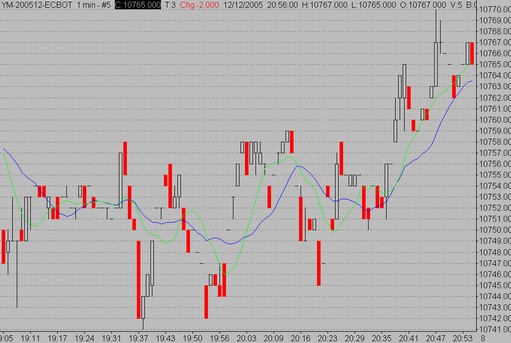
Via the website of the Chicago Board of Trade (CBOT) where the mini Dow Jones is traded I came across this article about scalping the mini DOW. A very interesting article by no means but the essential part, where the writer describes his trade setups I got doubts. He is using a one minute chart and solely trade SMA crossovers of 9 and 16. He is taking all the trades, which "keeps him on the right side of the of the DOW for most of the day" as he says and he uses no indicators and focuses solely on current supply and demand. He gave this chart as an example to show how profitable this system works for him. Yeah.


Well this is how I look at my chart one a one minute basis: It gives me so many trades which will eat ayay my profits and result in a big loss. Or do I use another chart than this guy does?


Selasa, 07 Februari 2006

DOW SYSTEM AND MARKETS UPDATE

It has been a few days not posting here, too busy with other things. My forward testing of the mini DOW Jones (I am trading it in simulation mode, software also available on the site of CBOT) gave some surprises: it forced me to go overnight several times in a row.
This changes a daytrading system into a positiontrading one. This has consequences: first my riskmanagement changes due to possible gaps occurring on the DOW frequently. Gaps can be huge on the DOW: 50 or 70 points do occur on a regular basis. Secondly, the margin is withdrawn from my account so my regular trading can be influenced the next day. I will test it further but results or not negative for the moment.


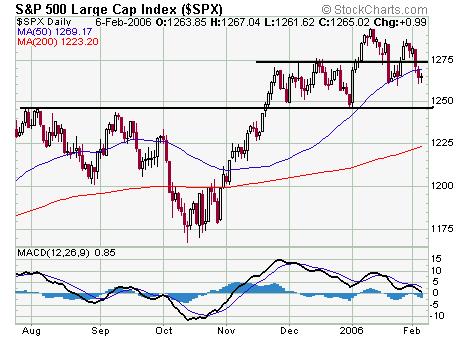
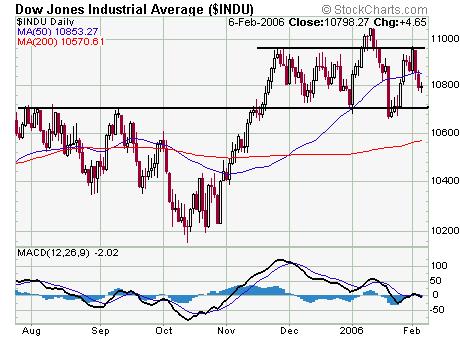
A few charts of the markts. The S@P500 and the DOW moving sideways in a range which started at the end of November last year, but below their respective 50 daily SMA. Futures a little lower at the moment. We may test the lower range in these days, see charts below.


Rabu, 01 Februari 2006

SYSTEM DEVELOPMENT

In developping a trade system on the BUND the aspect of the Profit/Loss ratio worried me and still does. No system will ever be perfect, you have to find a tradeable system. Now in my backward and forward testing I got a P/L ratio of 1. This means on average one loser on two trades. So it is crucial that my winning trades are bigger than my losers.


I mentioned before the bad spread of the BUND, this comes in especially if you have a system with a P/L of 1. Suppose you have with the BUND a loser of 10 points and a winner of 10 points. What will be the result? The spread is 1 point, so the loss on the losing trade will be 12 points, whilst your win of the winning trade will be 8 points. Net is this a loss of 4 points, besides the transactions costs. 4 Points being 40% of the trade...
So my winning trades have to be at least 1.4 times bigger than my losing trades.


Related Posts Plugin for WordPress, Blogger...