For me consistency has always been a very important and interesting factor in trading. By consistency I mean how long, in a given timeframe, let say 12 months or 12 weeks, my trades are giving a positive result. Can I expect 6 months out of 12 being profitable or more or less? This is one of the questions which I always try to give as best as possible an answer.
One of the most used criteria for evaluating fund managers is the Sharpe Ratio. The Sharpe Ratio is used for this because of its easy use: the bigger the Sharpe the better the fund or the fund manager. This almost has become fait accompli.
How is the Sharpe Ratio calculated? It is simple obtained by dividing the average net profit (mean or expectation E) by the standard deviation of the trades. The standard deviation is, as you may know, a measure for the spread of winners of losers around the mean. Because the deviation is a measure for the trade spread it is also considered as a measure for the risk of the fund or the fund manager, but this standard deviation is also defined as the volatility of the fund.
The Sharpe ratio is in this way defined as the mean profit of the fund (-manager) per point risk or volatility. The bigger the mean, the bigger the Sharpe the better the fund (-manager) is performing. That's the idea.
An example. Suppose trader A has a gain of 5 ES points per trade, a spread of 10 points, done over 100 trades in one year. This means that, when trader's A profits are normally distributed over the losses and the winners, 99,73% of his trade outcomes is lying between 5 minus 30 (=-20) and 5+ 30 (=35). The Sharpe ratio is now 5/10 = 0.5 .
Do you see how it works? When the trade outcomes would have a bigger spread but with the same mean the Sharpe ratio would decrease, the mean per point risk will decrease.
When you look closely at the Sharpe Ratio you will see and understand that is in fact a measure for consistency. To see this take the next example. Trader B takes 100 trades a year but with every trade being a winner (if this would be possible, but for clarity reasons taken here) for 5 points. His net profitability and mean is the same as for trader A but his Sharpe ratio becomes 5/∞ = ∞. His consistency is 100%.
We defined the Sharpe ratio as the mean defined by the spread. This is not precisely correct. The exact definition is the excess profit over a zero risk profit divided by the spread. A zero risk is generally the return of a 30 year T-bond but also a European long bond could be taken. Off course the risk is not exactly zero but is considered to be and also T- bond returns are changing over time (inflation).
Our definition of the Sharpe is a modified Sharpe, but it doesn't really matter, because the exact definition doesn't give more information. You only have bear in mind how the Sharpe is defined when it is used in comparisons.
There is a clear relation with so called z score of a normal distribution and a lookup in a table with a z 0f ∞ gives a 100% consistency. In this way consistency can be defined and I use it this way.
But before closing this post three remarks have to be made.
1. The Sharpe and the consistency is defined for normal distributed trade returns but in practice returns seldom are.
2. The spread as a measure is not a very good one because in this way it also takes positive returns as a risk and this is not what traders and investors generally feel about positive returns.
3. The longer a trader stays in business the bigger his draw downs will be. Or said otherwise: the more trades a fund manager takes the bigger his draw downs will be, or said it in another way: the more trades a fund manager takes, how bigger his drawdown. The consequence is that the longer a fund manager is in business (the longer a fund exists) he will be punished with a lowering of his Sharpe ratio. I will come back to this in my next post.
So the conclusion is that Sharpe is a useful concept but not more and so other concepts for consistency are needed. These are the Sortino Ratio, Callmar ratio and the Martin Ratio. I developed another concept of consistency which I called Excess Loss Wealth Function (ELWF) which I draw directly from the theory of random walks.
Selasa, 12 Desember 2006
Minggu, 03 Desember 2006
TRADE SYSTEMS AS SUCH
Last time I was talking about expectations and the use of stops. One of the things that interested me was the relation between a stop and other system parameters like amount of losses/winners and the average win/loss. I stated that for a given trade system a clear relation between these parameters doesn't exist.
But, as you may have noticed in earlier postings I wrote about the win ratio and it's relation to expectation. I described expectation in terms of win ratio (chance of a winner) and one of the things I found was a clear relation between the win ratio and the profit ratio (= average/average loss. From the figure given there some conclusions cold be drawn how big the profit ratio has to be with a given win ratio for the expectancy to be positive.
Now, you could ask, is this in contradiction with findings in my last post?. It is maybe a surprise but I think there isn't.
When I tried to describe a relation between expectancy and win ratio I was primarily interested to let you see the importance of a high win ratio, in contrary to some, or most, writers who stress the importance of an overall profit but ignore to tell you the serious problems you encounter when your trading systems comes up with only a few winners and a bunch of losers. They may be right but is it workable, see my last posting about expectancy and win ratio
So, in these postings I was comparingdifferent trade systems to each other. I then focussed one a particular system and its parameters. I have a strong conviction in the existence of trade systems as such, whose trade parameters are fixed. I think of trade systems as being some entity that produces so and so many trades a year, with a certain expectation per trade and profit factor. Seeing systems this way it is no longer a contradiction to say that parameters of a system in particular are dependant.
Now, the question is now as follows. When I or you try to trade this system, do we get the same results as theoretically would be possible? I already posted before about this (Luck and Randomness) and I suspected then some interesting aspects of trading on which I want to post in the future.
But, as you may have noticed in earlier postings I wrote about the win ratio and it's relation to expectation. I described expectation in terms of win ratio (chance of a winner) and one of the things I found was a clear relation between the win ratio and the profit ratio (= average/average loss. From the figure given there some conclusions cold be drawn how big the profit ratio has to be with a given win ratio for the expectancy to be positive.
Now, you could ask, is this in contradiction with findings in my last post?. It is maybe a surprise but I think there isn't.
When I tried to describe a relation between expectancy and win ratio I was primarily interested to let you see the importance of a high win ratio, in contrary to some, or most, writers who stress the importance of an overall profit but ignore to tell you the serious problems you encounter when your trading systems comes up with only a few winners and a bunch of losers. They may be right but is it workable, see my last posting about expectancy and win ratio
So, in these postings I was comparingdifferent trade systems to each other. I then focussed one a particular system and its parameters. I have a strong conviction in the existence of trade systems as such, whose trade parameters are fixed. I think of trade systems as being some entity that produces so and so many trades a year, with a certain expectation per trade and profit factor. Seeing systems this way it is no longer a contradiction to say that parameters of a system in particular are dependant.
Now, the question is now as follows. When I or you try to trade this system, do we get the same results as theoretically would be possible? I already posted before about this (Luck and Randomness) and I suspected then some interesting aspects of trading on which I want to post in the future.
Selasa, 28 November 2006
STOPS AND TRADING SYSTEMS
It is common to use stops to avoid big losses and to avoid the psychological danger a trader can have when he is uncertain to close his positions at time.
Still sometimes no stop is proposed in trading. We all now that too small a stop the will punch out too often, sometimes leaving us behind with a potential winner while too big a stop can have a big influence on our overall results.
Suppose someone trades 100 times a year of which 80% are small winners and mall losers. This is not an unreal situation for a discretionary trader. His results are determined by the last 20% which we suppose to be big winners and big losers.
The influence of one of such a trade is substantial. A big loser or big winner can make a substantial difference to the final results of the trader.
But the question remains if how losers and winners effect each ohter.
We know the concept of Expectancy:
E = P / NP - L / NL = Average Win – Average Loss (1)
In words: The expectation of a trade is the total win divided by the total amount of losses minus the total loss divided by the total amount of losers.
The above formula has four variables, P the total win, L, the total loss, NP the amount of winners and NL the amount of losers. Each of them can be changed, e.g. decreasing the the total loss L, decreases the average loss and so increases the sum which is the expectation E.
But changing one variable in formula (1), changing one may affect the other ones. The variables are said to be dependant from each other. For a given system, changing the average loss may result in changing the average win too!
An example: a system produces 100 trades a year, 60 losers and 40 winners. When 5 potential losses could eventually turned into 5 winners by taking a bigger stop the average win will increase due to this, but you may also expect that the average loss will increase due to the bigger stop of the remaining 35 losses. We also could go for bigger winners just to see an increase in the amount of losses.
We don’t know at forehand what happens and the problem stays. Suppose there is a function G with parameters NP, NL, P, L so that :
G (NP,NL,P,L).
G produces some results in terms of expectation E:
G (NP,NL,P,L) = f (E) (2)
I did some effort to investigate some general characteristics of formula (2). Though not being very being successfully it helped me I a better understanding the concept of a trading system, in fact a way of producing losers and winners which outcomes are dependant to each other.
One of the strangest things I found was that the outcome of a system is changing over time and not seldom worsening, not necessarily in terms of expectation E or E per dollar risk but more in terms of other characteristics as drawdown, amount of losses and winners, runs of losses and winners and so on.
This is a fundamental (stochastic) principle everywhere probability plays such an important role.
Still sometimes no stop is proposed in trading. We all now that too small a stop the will punch out too often, sometimes leaving us behind with a potential winner while too big a stop can have a big influence on our overall results.
Suppose someone trades 100 times a year of which 80% are small winners and mall losers. This is not an unreal situation for a discretionary trader. His results are determined by the last 20% which we suppose to be big winners and big losers.
The influence of one of such a trade is substantial. A big loser or big winner can make a substantial difference to the final results of the trader.
But the question remains if how losers and winners effect each ohter.
We know the concept of Expectancy:
E = P / NP - L / NL = Average Win – Average Loss (1)
In words: The expectation of a trade is the total win divided by the total amount of losses minus the total loss divided by the total amount of losers.
The above formula has four variables, P the total win, L, the total loss, NP the amount of winners and NL the amount of losers. Each of them can be changed, e.g. decreasing the the total loss L, decreases the average loss and so increases the sum which is the expectation E.
But changing one variable in formula (1), changing one may affect the other ones. The variables are said to be dependant from each other. For a given system, changing the average loss may result in changing the average win too!
An example: a system produces 100 trades a year, 60 losers and 40 winners. When 5 potential losses could eventually turned into 5 winners by taking a bigger stop the average win will increase due to this, but you may also expect that the average loss will increase due to the bigger stop of the remaining 35 losses. We also could go for bigger winners just to see an increase in the amount of losses.
We don’t know at forehand what happens and the problem stays. Suppose there is a function G with parameters NP, NL, P, L so that :
G (NP,NL,P,L).
G produces some results in terms of expectation E:
G (NP,NL,P,L) = f (E) (2)
I did some effort to investigate some general characteristics of formula (2). Though not being very being successfully it helped me I a better understanding the concept of a trading system, in fact a way of producing losers and winners which outcomes are dependant to each other.
One of the strangest things I found was that the outcome of a system is changing over time and not seldom worsening, not necessarily in terms of expectation E or E per dollar risk but more in terms of other characteristics as drawdown, amount of losses and winners, runs of losses and winners and so on.
This is a fundamental (stochastic) principle everywhere probability plays such an important role.
Kamis, 16 November 2006
AUTOMATED TRADING
One reason of not being updating recently is a circumstance that I never thought would be important to me. I met a few years ago a trader which became also a friend and after numerous discussions about trading we decided this summer to join and trade some systems I looked at the last years.
This trader would do the actual trading so that would let me time to do my own trading. A good plan until he decided not to trade because of private reasons which left us with the question how to proceed. Go on with it or not. We wanted to proceed but it would mean I had to make the trading efforts.
It was than that I thought about a fully automated trading system (ATS), so that the computer would take the decisions of taking the trading, managing it and closing it. This is not an easy task.
First of all I had to consider my trading configuration. I trade with Interactivebrokers, a broker which also delivers the data. My charting program is SierraCharts and I use a Bracket Trader as a front end program. I am aware of the lacks and the failures of this configuration. I always look at other possibilities but it is somehow difficult to change what you are used to but besides that IB is very cheap and reliable.
I looked for programs doing he job but I did not found it. Tradebolt suggest doing just this but did not convince me. Than I found the website of this German guy, Juergen. On his website he offers a Replay module for back testing Sierra charts but also offers some kind of rudimentary ATS for SierraCharts and Bracket Trader, called fscript. It is written in VBScript of which the bron code is free; an ATS sample can be read and this was what I needed.
The last time I programmed was maybe 20 years ago in old languages as Pascal and Fortran. Programming in a script language was completely new to me and I have to admit it was by far not easy but finally succeeded. It was a very nice surprise to me that Juergen offered his help where he could.
What does fscript do? Simply said it reads data from SieraCharts, decides if a trade has to follow, and send it through Bracket trader to my broker. After weeks of testing it runs now completely free of hands. The only thing to do is to start the program. Off course I have to monitor it because with such a ATS in place something unexpected can happen.
The system is a combination of the FDAX, and two BUND future systems. I hope this will give me and my partner good trading results. The most satisfying was the completion of the ATS itself which enables us to develop and trade future systems automatically and independantly.
This trader would do the actual trading so that would let me time to do my own trading. A good plan until he decided not to trade because of private reasons which left us with the question how to proceed. Go on with it or not. We wanted to proceed but it would mean I had to make the trading efforts.
It was than that I thought about a fully automated trading system (ATS), so that the computer would take the decisions of taking the trading, managing it and closing it. This is not an easy task.
First of all I had to consider my trading configuration. I trade with Interactivebrokers, a broker which also delivers the data. My charting program is SierraCharts and I use a Bracket Trader as a front end program. I am aware of the lacks and the failures of this configuration. I always look at other possibilities but it is somehow difficult to change what you are used to but besides that IB is very cheap and reliable.
I looked for programs doing he job but I did not found it. Tradebolt suggest doing just this but did not convince me. Than I found the website of this German guy, Juergen. On his website he offers a Replay module for back testing Sierra charts but also offers some kind of rudimentary ATS for SierraCharts and Bracket Trader, called fscript. It is written in VBScript of which the bron code is free; an ATS sample can be read and this was what I needed.
The last time I programmed was maybe 20 years ago in old languages as Pascal and Fortran. Programming in a script language was completely new to me and I have to admit it was by far not easy but finally succeeded. It was a very nice surprise to me that Juergen offered his help where he could.
What does fscript do? Simply said it reads data from SieraCharts, decides if a trade has to follow, and send it through Bracket trader to my broker. After weeks of testing it runs now completely free of hands. The only thing to do is to start the program. Off course I have to monitor it because with such a ATS in place something unexpected can happen.
The system is a combination of the FDAX, and two BUND future systems. I hope this will give me and my partner good trading results. The most satisfying was the completion of the ATS itself which enables us to develop and trade future systems automatically and independantly.
Minggu, 05 November 2006
Learn The 15 Debt Elimination Steps You Must Take Immediately!
What Everybody Needs To Know...Learn The Truth About Debt Elimination!
Here`s how we have been taught to charge, charge, charge and promised Easy monthly payments by advertisers who seduce us into debt. So its no accident that the credit, finance and loan companies end up with most of our money, while we end up with all of the bills.
Debt Elimination tips shows how Millions of Americans are living on the edge of financial disaster surviving only on the hope of next week's paycheck. The average American is dying under a load of debt, with little or nothing building in the bank or in investments.
Debt Elimination Tips, shows how we've been misled!
See for the first time how the entire way our economy works, is designed to make you work yourself to exhaustion--simply to accumulate wealth for the companies you do business with--Not For You.
The most staggering example of this is a home mortgage. Say you bought a home with a 30-year conventional or adjustable rate mortgage, you will pay for that loan about THREE TIMES. Just multiply out your payment times 360 months and you will see that the total is about 3 times the value of the money you borrowed.
Say you buy a $250,000 home, with a $200,000 mortgage; you will end up paying about $600,000 over 30 years. This means that you will pay nearly $400,000 dollars in interest! Just for the privilege of using their $200,000.
That means that two-thirds of that total is interest. Interest is the profit the Mortgage Company makes for lending you the money to buy the house. And they feel that you should pay them back THREE TIMES. That's 200% interest!
Debt elimination tips -- Now let these words soak into your mind and heart: You will have to work...week after week...year after year...to earn FOUR HUNDRED THOUSAND DOLLARS---Just so you can give it to the bank to make them rich!
Debt Elimination Tips, Show's how bad it really is to use credit cards and to make only the minimum payments!
Suppose you bought $2,000 worth of furniture on a typical (19.8% interest with a $40 annual fee) credit card, and you paid only the minimum monthly payments requested by the credit card company (here's why they only ask for a minimum payment), it will take you 31 years and 2 months to pay it off.
Plus--In addition to the original $2,000 cost of the furniture-- you would have paid $8,202 in interest,(if you make the minimum payments) just for the privilege of using their $2,000! That's five times the furniture's value! Long after you had thrown the furniture out, you would be draining your wealth away paying for it.
Banks, finance, creditors and credit card companies have encouraged indebtedness.
According to a study by the United States Department of Health and Human Services, 96% of Americans never achieve financial independence. They end up depending on charity, family, government welfare or they're forced to keep working just to survive!
Debt Elimination Tips, Why turn your hard-earned money over to the credit card companies? When you don't have too. Follow a proven debt elimination plan!
A new survey by the American Bankers Association found that 45% of credit card holders with incomes between $50,000 and $100,000 never pay off their balances. Many others don't even make the minimum payments and fall behind on the interest. (Palm Beach Post, Oct 7, 1998)
Debt elimination tips shows how the average American will make over $1,000,000 in his or her working lifetime, and will have as much as 67% to 80% of their money Legally Stolen from them in the form of many different types of federal, state, local taxes and interest on borrowed money!
Are you tired of living paycheck-to-paycheck, month-to- month, making minimum payments, with little hope of ever getting ahead?
Debt elimination tips You Can Start Using Today!
1. Begin eliminating all debts.
2. Write down everything you purchase, determining where your money is going is half the battle on your road to becoming debt free and critical to your future financial success. Seeing it in black and white can give you a new perspective.
3. Pay cash whenever possible.
4. Cut up and cancel all your credit cards, Using a debit card instead of a credit card gives you all the convenience of a credit card but withdraws money immediately from your checking account, so you can not dig yourself back into debt.
5. Never fall into the habit of making only minimum payments.
6. Pay the most you can afford.
7. Put money-saving tips into practice, when possible shop at outlet malls, wholesale clubs and take advantage of coupons.
8. Avoid the trap of thinking in monthly payments.
9. Consider the total cost of purchasing goods and services on credit and compare that with cash savings. You'll pay cash every time.
10. Compare the interest charged on your debts with the interest earned on your savings and investments. You'll find it makes more sense to resolve all debts before beginning a savings or investment program.
11. Debt consolidation loans: be very careful your monthly payments will be lower, but you may lose in the long run, because those lower monthly payments will be spread over a longer period of time. If you don't change your spending habits Now, you could easily end up in worst trouble down the road!
12. Bargain for a better deal: Don't be afraid to negotiate with your creditors many will be willing to Freeze your interest on your outstanding balances in return for automatic monthly payments.
13. Avoid the Quick-Fix companies. Many will charge you a lot of money Up Front, but very few will genuinely help you in the long run.
14. Don't promise away your future income by cashing out part of your retirement savings early to pay down your current debt. You will have to pay Current federal and state taxes, Plus an early withdrawal penalty on that money. You are borrowing against your future, just to pay your current debts and to continue Living a lifestyle beyond your means.
15.Avoid filing for bankruptcy.
http://www.debt-elimination-program-reviews.com is run by Vincent Dail. They review and then list some of the best debt elimination, programs, software and books available online!
Here`s how we have been taught to charge, charge, charge and promised Easy monthly payments by advertisers who seduce us into debt. So its no accident that the credit, finance and loan companies end up with most of our money, while we end up with all of the bills.
Debt Elimination tips shows how Millions of Americans are living on the edge of financial disaster surviving only on the hope of next week's paycheck. The average American is dying under a load of debt, with little or nothing building in the bank or in investments.
Debt Elimination Tips, shows how we've been misled!
See for the first time how the entire way our economy works, is designed to make you work yourself to exhaustion--simply to accumulate wealth for the companies you do business with--Not For You.
The most staggering example of this is a home mortgage. Say you bought a home with a 30-year conventional or adjustable rate mortgage, you will pay for that loan about THREE TIMES. Just multiply out your payment times 360 months and you will see that the total is about 3 times the value of the money you borrowed.
Say you buy a $250,000 home, with a $200,000 mortgage; you will end up paying about $600,000 over 30 years. This means that you will pay nearly $400,000 dollars in interest! Just for the privilege of using their $200,000.
That means that two-thirds of that total is interest. Interest is the profit the Mortgage Company makes for lending you the money to buy the house. And they feel that you should pay them back THREE TIMES. That's 200% interest!
Debt elimination tips -- Now let these words soak into your mind and heart: You will have to work...week after week...year after year...to earn FOUR HUNDRED THOUSAND DOLLARS---Just so you can give it to the bank to make them rich!
Debt Elimination Tips, Show's how bad it really is to use credit cards and to make only the minimum payments!
Suppose you bought $2,000 worth of furniture on a typical (19.8% interest with a $40 annual fee) credit card, and you paid only the minimum monthly payments requested by the credit card company (here's why they only ask for a minimum payment), it will take you 31 years and 2 months to pay it off.
Plus--In addition to the original $2,000 cost of the furniture-- you would have paid $8,202 in interest,(if you make the minimum payments) just for the privilege of using their $2,000! That's five times the furniture's value! Long after you had thrown the furniture out, you would be draining your wealth away paying for it.
Banks, finance, creditors and credit card companies have encouraged indebtedness.
According to a study by the United States Department of Health and Human Services, 96% of Americans never achieve financial independence. They end up depending on charity, family, government welfare or they're forced to keep working just to survive!
Debt Elimination Tips, Why turn your hard-earned money over to the credit card companies? When you don't have too. Follow a proven debt elimination plan!
A new survey by the American Bankers Association found that 45% of credit card holders with incomes between $50,000 and $100,000 never pay off their balances. Many others don't even make the minimum payments and fall behind on the interest. (Palm Beach Post, Oct 7, 1998)
Debt elimination tips shows how the average American will make over $1,000,000 in his or her working lifetime, and will have as much as 67% to 80% of their money Legally Stolen from them in the form of many different types of federal, state, local taxes and interest on borrowed money!
Are you tired of living paycheck-to-paycheck, month-to- month, making minimum payments, with little hope of ever getting ahead?
Debt elimination tips You Can Start Using Today!
1. Begin eliminating all debts.
2. Write down everything you purchase, determining where your money is going is half the battle on your road to becoming debt free and critical to your future financial success. Seeing it in black and white can give you a new perspective.
3. Pay cash whenever possible.
4. Cut up and cancel all your credit cards, Using a debit card instead of a credit card gives you all the convenience of a credit card but withdraws money immediately from your checking account, so you can not dig yourself back into debt.
5. Never fall into the habit of making only minimum payments.
6. Pay the most you can afford.
7. Put money-saving tips into practice, when possible shop at outlet malls, wholesale clubs and take advantage of coupons.
8. Avoid the trap of thinking in monthly payments.
9. Consider the total cost of purchasing goods and services on credit and compare that with cash savings. You'll pay cash every time.
10. Compare the interest charged on your debts with the interest earned on your savings and investments. You'll find it makes more sense to resolve all debts before beginning a savings or investment program.
11. Debt consolidation loans: be very careful your monthly payments will be lower, but you may lose in the long run, because those lower monthly payments will be spread over a longer period of time. If you don't change your spending habits Now, you could easily end up in worst trouble down the road!
12. Bargain for a better deal: Don't be afraid to negotiate with your creditors many will be willing to Freeze your interest on your outstanding balances in return for automatic monthly payments.
13. Avoid the Quick-Fix companies. Many will charge you a lot of money Up Front, but very few will genuinely help you in the long run.
14. Don't promise away your future income by cashing out part of your retirement savings early to pay down your current debt. You will have to pay Current federal and state taxes, Plus an early withdrawal penalty on that money. You are borrowing against your future, just to pay your current debts and to continue Living a lifestyle beyond your means.
15.Avoid filing for bankruptcy.
http://www.debt-elimination-program-reviews.com is run by Vincent Dail. They review and then list some of the best debt elimination, programs, software and books available online!
Minggu, 27 Agustus 2006
Building Credit Ideas
There are several ways that we can build credit. If you are
tired of collectors hounding you, or if you are frustrated that
no one will loan you money because you never had credit, it is
time to learn how to build your credit. First, and foremost
never purchase items you do not need. If you 'want', do not let
your wants wear you down and get you deeper in debt. If you are
searching to build credit and have no history at all, make sure
you have your priorities in order.
Bad Credit Building Credit
If you have, bad credit get a DO-IT-YOURSELF-Kit and gets the
balls rolling. You can go to your public library and get books
that will guide you through the steps of repairing your credit.
Most libraries allow you to copy and print forms that you must
fill out and then send to your credits.
There are systematic guides at your local library that has the
tools for instructor debtors how to write letters to creditors.
Letters are probably better than phoning creditors, since some
creditors could care less about your situation and may threaten
you. Another good reason for writing letters is that (copy in
writing) is more valuable in a courtroom than a conversation on
the phone. If something is said or an agreement is reached and
the creditor later denies his or her claims then you can
present this to any courtroom and they will listen to you
first. Any documents that pertain to your credit history should
be stored in a safe area. If you send letters to your creditors
keep a copy of each letter sent and store it in a safe area. If
you notice any errors on your bills or credit, reports make sure
that you contact the appropriate professionals and dispute the
charges immediately. If you have credit cards and used the card
to purchase an item or use a service and this person sold you a
defected item or else provided bad service, you DO NOT have to
make payment toward the charges. You do however have to dispute
the charges with the services or stores that sold you the
product or service. If the sources refuse to give you an item
usable, or else reimburse you for a service or product you have
the right to deny payment.
Once you have disputed the charges with the sources you will
then contact your card provider and let them know what
occurred. If you are lucky enough to have a credit card with
bad credit, use the card to repay your debts and then meet the
monthly installments on the credit card each month. Ironically,
you are getting out of debt while going in debt deeper. It is a
solution when all else false. In other words, if you use the
card to pay your debts each month and then payoff your credit
cards the following month and then turnaround and uses the card
to pay that month bills..
Now you see where I am going. Credit cards have interest rates
so the bills each month on the card will increase.
No, Credit.No Problem
I do not need a credit line or credit card; I pay all my bills
each month with money. Is this you? Well then, you have the
obvious answer, but what if.
In today's world, we are moving into an era that requires us to
have at least one major credit card. When you phone any business
where you have debts, they will first ask you to pay with a
credit card. If you go apply for a job, apartment, mortgage,
car loan, or any other credit line you most likely will get a
rejection notice in the mail. Most lenders will not give credit
to anyone that has no credit history. The reason is that we are
expected to establish a credit line when we are teens, and if
we do not the lenders are often suspicious. The lenders do not
have an idea and can only base their judgments of you on
assumptions. Can I assume this person will make monthly
payments on time? Has this person taken for granted a loan from
a friend or family member in the past and there are no records
available for me to see if it is true? There are many reasons
that lenders will refuse you a loan if you do not have a credit
history. The best solution is starting up a line of credit now,
pay off your dues on time and avoid making purchases on items
you do not really need. Staying out of debt means regulating
your money each month and paying your bills on time.
About The Author: Son Ngo is the editor at
http://www.vkhowto.com, a community shared "How To" website on
everyday tricks and tips. You can share your expertises and
experiences to the world by submitting your article at the
website.
tired of collectors hounding you, or if you are frustrated that
no one will loan you money because you never had credit, it is
time to learn how to build your credit. First, and foremost
never purchase items you do not need. If you 'want', do not let
your wants wear you down and get you deeper in debt. If you are
searching to build credit and have no history at all, make sure
you have your priorities in order.
Bad Credit Building Credit
If you have, bad credit get a DO-IT-YOURSELF-Kit and gets the
balls rolling. You can go to your public library and get books
that will guide you through the steps of repairing your credit.
Most libraries allow you to copy and print forms that you must
fill out and then send to your credits.
There are systematic guides at your local library that has the
tools for instructor debtors how to write letters to creditors.
Letters are probably better than phoning creditors, since some
creditors could care less about your situation and may threaten
you. Another good reason for writing letters is that (copy in
writing) is more valuable in a courtroom than a conversation on
the phone. If something is said or an agreement is reached and
the creditor later denies his or her claims then you can
present this to any courtroom and they will listen to you
first. Any documents that pertain to your credit history should
be stored in a safe area. If you send letters to your creditors
keep a copy of each letter sent and store it in a safe area. If
you notice any errors on your bills or credit, reports make sure
that you contact the appropriate professionals and dispute the
charges immediately. If you have credit cards and used the card
to purchase an item or use a service and this person sold you a
defected item or else provided bad service, you DO NOT have to
make payment toward the charges. You do however have to dispute
the charges with the services or stores that sold you the
product or service. If the sources refuse to give you an item
usable, or else reimburse you for a service or product you have
the right to deny payment.
Once you have disputed the charges with the sources you will
then contact your card provider and let them know what
occurred. If you are lucky enough to have a credit card with
bad credit, use the card to repay your debts and then meet the
monthly installments on the credit card each month. Ironically,
you are getting out of debt while going in debt deeper. It is a
solution when all else false. In other words, if you use the
card to pay your debts each month and then payoff your credit
cards the following month and then turnaround and uses the card
to pay that month bills..
Now you see where I am going. Credit cards have interest rates
so the bills each month on the card will increase.
No, Credit.No Problem
I do not need a credit line or credit card; I pay all my bills
each month with money. Is this you? Well then, you have the
obvious answer, but what if.
In today's world, we are moving into an era that requires us to
have at least one major credit card. When you phone any business
where you have debts, they will first ask you to pay with a
credit card. If you go apply for a job, apartment, mortgage,
car loan, or any other credit line you most likely will get a
rejection notice in the mail. Most lenders will not give credit
to anyone that has no credit history. The reason is that we are
expected to establish a credit line when we are teens, and if
we do not the lenders are often suspicious. The lenders do not
have an idea and can only base their judgments of you on
assumptions. Can I assume this person will make monthly
payments on time? Has this person taken for granted a loan from
a friend or family member in the past and there are no records
available for me to see if it is true? There are many reasons
that lenders will refuse you a loan if you do not have a credit
history. The best solution is starting up a line of credit now,
pay off your dues on time and avoid making purchases on items
you do not really need. Staying out of debt means regulating
your money each month and paying your bills on time.
About The Author: Son Ngo is the editor at
http://www.vkhowto.com, a community shared "How To" website on
everyday tricks and tips. You can share your expertises and
experiences to the world by submitting your article at the
website.
TRADINGSYSTEMS AND THEORY
You may have wondered why I didnot update my blog regularly this summer. The resaon is quite boring: I went back to my study to work on several aspects on my tradingsystem.
I have to admit I worked at this for quite a long time before but the last months I focussed on some of them. Trading is a live time endeavour and by no means you will get all the answers but trying to see where u can go is a challenge by itself.
The things of my interest are:
1. Can something be said about drawdowns and losses for a given tradingsystem?
2. Can you expect bigger losses than your backtesting and actual trading results shows?
3. What is the nature of my return distribution?
4. How do you know if a tradingsystem gives better results than random?
5. Is there a better measure for trading performance than the Sharpe Ratio?
6. What effect does stops and targets have on my tradingsystems?
7. What effect does autocorrelation and trade dependancies have on my tradingsystem?
8. Is it possible and if so ,how, to maximise my trading in terms of risk and return by combining different tradingsystems?
As you can see, quite a lot of questions to be answered and a lot of theoretical work so it is not surprising that I was surprised pleasantly by an article in Traders of september about a traders tournement which is held every year in Europe and organised by Emilio Tomasini (www.toptradercup.com).
Asking myself if I would try to. But how are the rules of the game, eg, how do they measure somones performances?
I have to admit I worked at this for quite a long time before but the last months I focussed on some of them. Trading is a live time endeavour and by no means you will get all the answers but trying to see where u can go is a challenge by itself.
The things of my interest are:
As you can see, quite a lot of questions to be answered and a lot of theoretical work so it is not surprising that I was surprised pleasantly by an article in Traders of september about a traders tournement which is held every year in Europe and organised by Emilio Tomasini (www.toptradercup.com).
Asking myself if I would try to. But how are the rules of the game, eg, how do they measure somones performances?
Kamis, 22 Juni 2006
MARKET UPDATE AND PREDICTABILITY
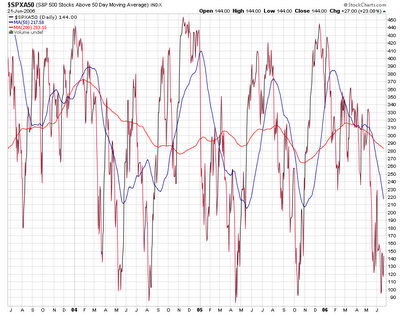
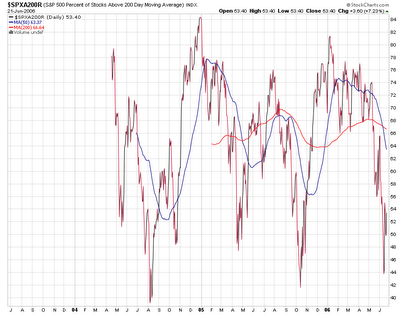
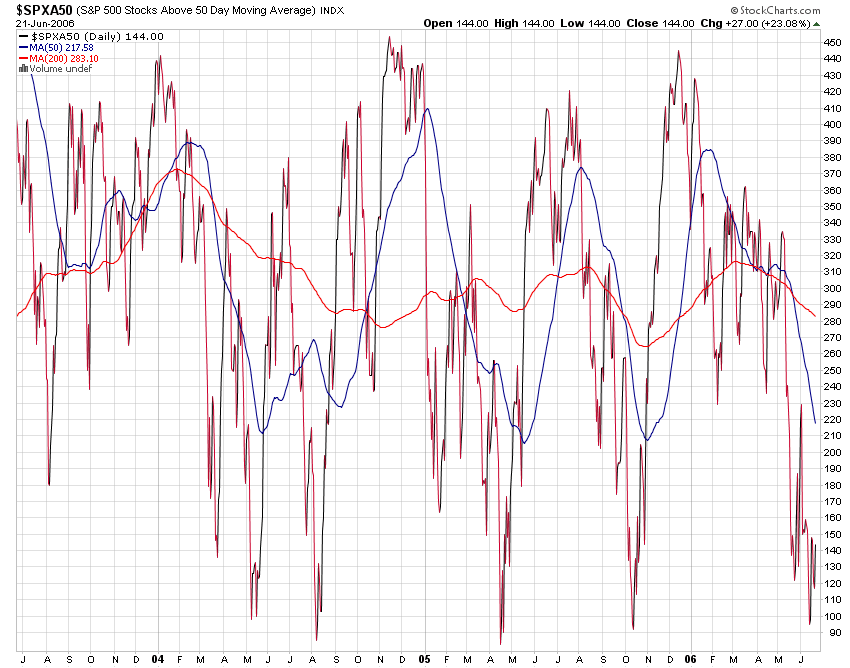
The markets in a decline at the moment, we can recognise that off course. If we look at stocks moving above 200 and 50 day moving average (symbols: $SPXA200 and $SPXA50), we can see that both are moving at the bottoms of recent years, see charts below.
If we are not too bearish about the current markets, and why would we? we may expect a recovery or at at least a sideways movement from here.
In Business week I found an interesting article about the predictability of market prices. I was posting earlier about it. If you think markets are moving in a random way, as some theoreticists postulate, it has no use to try finding a way getting more from the markets than the average benchmark (such as an indexfund) does.
I earlier summed up some opposite opinions about this view. Make up your mind. I agree with this writer when he says:
The first thing you need to do is convince yourself that the markets are not completely random. If the markets are completely random, no amount of research, emotional detachment, etc. will help. To continue to trade when you know the markets are random is to engage in gambling. Do you think that winning traders over a period of years gamble? I've been to Las Vegas many times and never put even a quarter in a slot machine.
Once you convince yourself the markets are not completely random, your search will take on new meaning. The challenge then becomes how do I locate non-random opportunities in the market so that I can exploit them?
From: Elitetrader Forum
If we are not too bearish about the current markets, and why would we? we may expect a recovery or at at least a sideways movement from here.
In Business week I found an interesting article about the predictability of market prices. I was posting earlier about it. If you think markets are moving in a random way, as some theoreticists postulate, it has no use to try finding a way getting more from the markets than the average benchmark (such as an indexfund) does.
I earlier summed up some opposite opinions about this view. Make up your mind. I agree with this writer when he says:
The first thing you need to do is convince yourself that the markets are not completely random. If the markets are completely random, no amount of research, emotional detachment, etc. will help. To continue to trade when you know the markets are random is to engage in gambling. Do you think that winning traders over a period of years gamble? I've been to Las Vegas many times and never put even a quarter in a slot machine.
Once you convince yourself the markets are not completely random, your search will take on new meaning. The challenge then becomes how do I locate non-random opportunities in the market so that I can exploit them?
From: Elitetrader Forum

SYSTEMTRADING | |
| DOW JONES | SUBSCRIBE THIS FEED |
Selasa, 13 Juni 2006
BEHAVIORAL FINANCE VS. EFFICIENT MARKET THEORY
There is an ungoing dispute between some scholars from financial universities and others over the effectiviness of technical analyses for predicting market movements.
Since the random walk model contends that price fluctuations occur randomly, technical systems which rely upon the existence of price trends cannot be profitable in the long run. The thought of a random walk being a condition and also an indication for the existence of an efficient market. Supportes of this theory deny the possibilty of predictability of pices on the stock market.
Others don't agree with this. There are studies that technical analyses do work, while even some question the efficient market theory itself eg. behavioral economist's as Tversky, Kahneman and Barberis. Some articles can be found below.
Since the random walk model contends that price fluctuations occur randomly, technical systems which rely upon the existence of price trends cannot be profitable in the long run. The thought of a random walk being a condition and also an indication for the existence of an efficient market. Supportes of this theory deny the possibilty of predictability of pices on the stock market.
Others don't agree with this. There are studies that technical analyses do work, while even some question the efficient market theory itself eg. behavioral economist's as Tversky, Kahneman and Barberis. Some articles can be found below.
- Trading System for Australian Dollar using multiple moving averages
- Unsystematic Futures Profits with technical Trading Rules
- A Survey Of Behavioral Finance
SYSTEMTRADING | |
| TECHNICAL ANALYSIS | SUBSCRIBE THIS FEED |
Kamis, 08 Juni 2006
SYSTEM DEVELOPMENT (AGAIN)
There are many aspects on trading which must be adressed before trading a system. Some of them can be found in the sidebar under Interesting Posts. The following will be treated on a next occasion.
As allways I am looking for new tradesytems besides retesting the current in use. You never know what the results will be of these exercises. One of the most compelling aspects of trading is the valuation of the drawdowns of a system. A drawdown defined as the maximum top-to-valley drop in the equity curve.
Drawdowns can be seen as extreme events in a ditribution of possibble events but due to their extreme values they are almost allways underestimated in statistics, especially in normal distributions.
A relatively new research field of statistics considers extreme values. This so called Extreme Value Theory not only studies the markets but has also applications to other fields as floodcontrol, sea waves and material exhaution models and so on.
The mathematics is as usual interesting but really very complicated. I will try to give a survey of my findings another time. Some articles:
The last couples of day I performed some trades, see my FDAX Trades and my DOW JONES Trades.
- consistency
- robustness
- traders psychology and behaviour
As allways I am looking for new tradesytems besides retesting the current in use. You never know what the results will be of these exercises. One of the most compelling aspects of trading is the valuation of the drawdowns of a system. A drawdown defined as the maximum top-to-valley drop in the equity curve.
Drawdowns can be seen as extreme events in a ditribution of possibble events but due to their extreme values they are almost allways underestimated in statistics, especially in normal distributions.
A relatively new research field of statistics considers extreme values. This so called Extreme Value Theory not only studies the markets but has also applications to other fields as floodcontrol, sea waves and material exhaution models and so on.
The mathematics is as usual interesting but really very complicated. I will try to give a survey of my findings another time. Some articles:
- Drawdown of A Brownian Motion
- Maximum Drawdown annd Risk Measure
- The Pros and Cons of “Drawdown” as a Statistical Measure of Risk for Investments
The last couples of day I performed some trades, see my FDAX Trades and my DOW JONES Trades.
| SYSTEMTRADING | SUBSCRIBE THIS FEED |
Kamis, 01 Juni 2006
LUCK AND RANDOMNESS
There is no doubt that luck or more general speaking randomness plays an important and unpredictable role in trading. Nobody can escape from this, be it in business, science, love or trading.
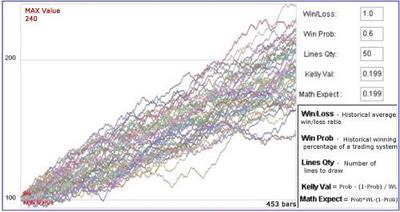
A computer simulation of a portfolio starting with equal amounts of money and trading the same system (win ratio of .6 and profit/loss factor of 1) reveals the following result. It is by any means a profitable system but while some portfolio's made a nearly 140% return, others suffer from bad drawdowns to only a 60 % return. This cannot be attributed to skillness or whatever, but is just a matter of randomness or luck which alters someones result. See graph below.
KEEP THIS IN MIND when trading, I find this a very disturbing but also a very reassuring thought at the same time, not everything is in our hands.
I traded yesterday very carefully on the FDAX before the FED's announcements. I never trade on news and I try to avoid these to interfer with my decisions but I know all to well that some news can disturb the markets on the short term very heavily and FED news is one of those newsfacts. My entries are given in the next chart arrowed at the upper side of the graph.
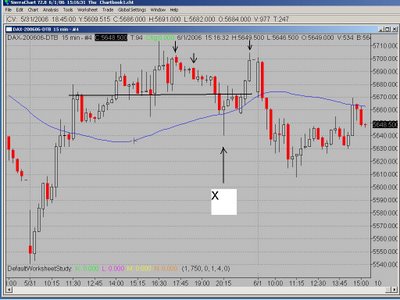
I traded the intraday 5670 level (lined). At arrow X, I hesitated to go short. I connected these moves with the FED and I decided not to enter. I was clearly lucky, no skill, just lucky. Later on the evening I entered long.
The DOW JONES for a couple of days now finding resistance at the 200 SMA. Also bouncing off the support at 1245. See S&P 500 today
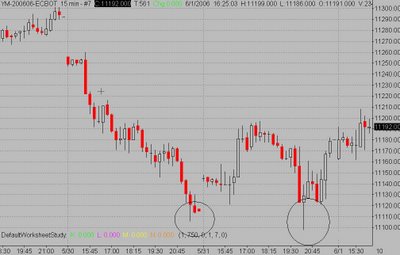
Looking at the markets today I am wondering if the DOW futue will show us up with a Adam and Eve doubble bottom, like the FDAX last week, see an intrady chart (eg. at yahoo finance), or below:
Daytrading
Dow Jones
FDAX
A computer simulation of a portfolio starting with equal amounts of money and trading the same system (win ratio of .6 and profit/loss factor of 1) reveals the following result. It is by any means a profitable system but while some portfolio's made a nearly 140% return, others suffer from bad drawdowns to only a 60 % return. This cannot be attributed to skillness or whatever, but is just a matter of randomness or luck which alters someones result. See graph below.

KEEP THIS IN MIND when trading, I find this a very disturbing but also a very reassuring thought at the same time, not everything is in our hands.
I traded yesterday very carefully on the FDAX before the FED's announcements. I never trade on news and I try to avoid these to interfer with my decisions but I know all to well that some news can disturb the markets on the short term very heavily and FED news is one of those newsfacts. My entries are given in the next chart arrowed at the upper side of the graph.

I traded the intraday 5670 level (lined). At arrow X, I hesitated to go short. I connected these moves with the FED and I decided not to enter. I was clearly lucky, no skill, just lucky. Later on the evening I entered long.
The DOW JONES for a couple of days now finding resistance at the 200 SMA. Also bouncing off the support at 1245. See S&P 500 today
Looking at the markets today I am wondering if the DOW futue will show us up with a Adam and Eve doubble bottom, like the FDAX last week, see an intrady chart (eg. at yahoo finance), or below:

Daytrading
Dow Jones
FDAX
Selasa, 30 Mei 2006
TRADING DIARY
I performed two trades on the FDAX and the mini DOW JONES
Normally I keep in WORD a diary after a trading day but I am looking for a software program to do this. Until now I didnot find a good program.
I finished a posting on Hellodax, about market participators, will be posted tomorrow.
Talking about diarries: this story about One Bad Trade performed is interesting stuff to read for anybody.
Normally I keep in WORD a diary after a trading day but I am looking for a software program to do this. Until now I didnot find a good program.
I finished a posting on Hellodax, about market participators, will be posted tomorrow.
Talking about diarries: this story about One Bad Trade performed is interesting stuff to read for anybody.
Jumat, 26 Mei 2006
THE MARKET NOW
I was thinking the last couple of days about the market and the doom scenario's some described, comparing this market with the fall of the late nineties after 1997, talking about inflation risks and FED's chairman Greenspan commenting about the market and inflation.
Off course the usual conspiracy theories always pop up.
Niederhoffer posting about the common errors made by forecasters, quite amusing to read.
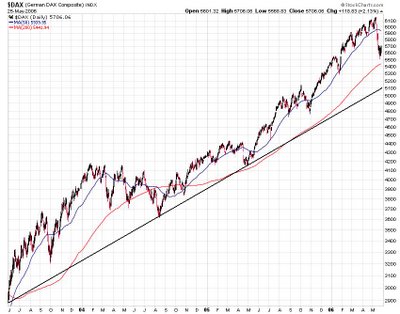
Markets started two weeks ago to go down rapidly, an end of a trend , off course I meant the trend of this year which started in November of last year; though the DAX still is in a big uptrend since 2003, see a classical uptrend in the chart below (click to enlarge).
Markets bounced up thursday, there were some clues though given by some. So Stephan Vita who posts this graph of the NYMO McClelan indicator, an indicator more often used by index followers, and asking the retorical question : "Why Does a Bounce Come?" ; it speaks for itself.
The S&P 500 bouncing off the 200 SMA very neatly: safed by the bell a least for the moment.
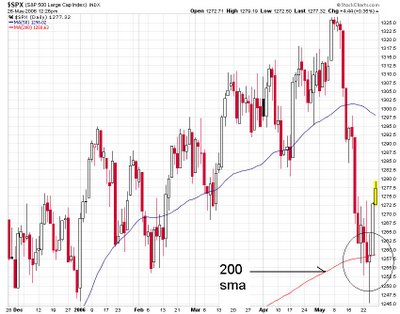
I am allways very cautious about predictions because who can predict the future? But to be honest I saw wednesday the FDAX nice bottoming out, with a double bottom and a positive divergence in price at C assuring at least a short term recovery.
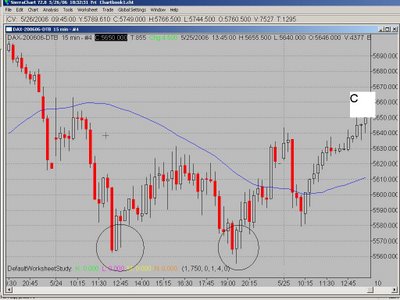
Also read again Niederhoffer when he is Briefly Speaking about the markets and about romance too :)
FDAX
Dow Jones
Off course the usual conspiracy theories always pop up.
Niederhoffer posting about the common errors made by forecasters, quite amusing to read.
Markets started two weeks ago to go down rapidly, an end of a trend , off course I meant the trend of this year which started in November of last year; though the DAX still is in a big uptrend since 2003, see a classical uptrend in the chart below (click to enlarge).

Markets bounced up thursday, there were some clues though given by some. So Stephan Vita who posts this graph of the NYMO McClelan indicator, an indicator more often used by index followers, and asking the retorical question : "Why Does a Bounce Come?" ; it speaks for itself.
The S&P 500 bouncing off the 200 SMA very neatly: safed by the bell a least for the moment.

I am allways very cautious about predictions because who can predict the future? But to be honest I saw wednesday the FDAX nice bottoming out, with a double bottom and a positive divergence in price at C assuring at least a short term recovery.

Also read again Niederhoffer when he is Briefly Speaking about the markets and about romance too :)
FDAX
Dow Jones
Rabu, 24 Mei 2006
EXPECTANCY AND WINRATIO (3)
One of the results of my last posting on expectancy is the size of average win compared to the average loss:
"With these examples we see that increasing the average win is more favourable for the expectancy and therefore the profability than decreasing the average loss, but also that increasing the win ratio proportional increasing the expectancy."
There is a restriction to these statements: this is only true for a winratio p < 1/2. I stated it here due to my own bias towards trading in the sense that I never look at tradingsystems with a winratio smaller than 1/2.
Although completely possible for someone to trade, it is not my cup of tea. You may find and trade a sytem which produces 3 winners out of ten, the winners to be bigger than the losers. See the graph for the expectancy in this case in my posting before. I personally discard these systems because of the following reasons.
I. The outlier problem.
One of the problems of data sampling and data processing is the uneven influence outliers have on the results. A big trade outcome may be not representative but just a coincidence. You have to watch for this trap. How many data do you need to obtain reliable results? Though allways important for valuating a trade system, for a system with the need of bigger winns (a trend following system) this becomes very urgent. You may be waiting for another winner which may never show up.
There is another practical problem: you may not miss the bigger trades , this is allways possible for many reasons, your final outcome of your system being very sensitive to pick these winners.
II. The psychology involved
It can be very hard to trade a system in which many losers occur in a row. You have to be very patient and disclipined to trade a system like that. Your account has to be big enough to take this easily, the risk of a gambler's ruin is allways at stake here.
III. Consistency
Time consistenccy is an important facor in my trading and may be treated on a next occasion. For the moment it is enough to note that consistency in trade systems with lower win ratio's only may be expected in longer lasting time frames, a result badly bearable for me.
IV.Formal reasons
There exists a rigorous and formal model for a maximum betting size based on the work of Dubins and Savage (1976) in their book with the inspiring title How to Gamble if you Must. One of their results was that in an unfair game, eg. a game where your win chances are less than 1/2 (a play in which the odds are against you) your maximum chances are only achieved when staking the maximum. This is called 'bold play' in these models.
Later work confirms these results, see eg. an overview of Schweinsburg : Improving on bold play when the gambler is restricted. For a superfair game, eg when p>1/2, it has been shown that a more realistic timid strategy of staking being optimal.
Now these models cannot directly transformed to trading systems because they are restricted to so called red and black models in which outcomes are either black or red (plus 1 or minus 1 and so on, the casino games) but may give some clues to sub-optimal strategies when using winratios > 1/2.
Related:
Systemtrading
Expectancy
"With these examples we see that increasing the average win is more favourable for the expectancy and therefore the profability than decreasing the average loss, but also that increasing the win ratio proportional increasing the expectancy."
There is a restriction to these statements: this is only true for a winratio p < 1/2. I stated it here due to my own bias towards trading in the sense that I never look at tradingsystems with a winratio smaller than 1/2.
Although completely possible for someone to trade, it is not my cup of tea. You may find and trade a sytem which produces 3 winners out of ten, the winners to be bigger than the losers. See the graph for the expectancy in this case in my posting before. I personally discard these systems because of the following reasons.
- The problem of outliers.
- Psychology involved
- Consistency
- Formal reasons
I. The outlier problem.
One of the problems of data sampling and data processing is the uneven influence outliers have on the results. A big trade outcome may be not representative but just a coincidence. You have to watch for this trap. How many data do you need to obtain reliable results? Though allways important for valuating a trade system, for a system with the need of bigger winns (a trend following system) this becomes very urgent. You may be waiting for another winner which may never show up.
There is another practical problem: you may not miss the bigger trades , this is allways possible for many reasons, your final outcome of your system being very sensitive to pick these winners.
II. The psychology involved
It can be very hard to trade a system in which many losers occur in a row. You have to be very patient and disclipined to trade a system like that. Your account has to be big enough to take this easily, the risk of a gambler's ruin is allways at stake here.
III. Consistency
Time consistenccy is an important facor in my trading and may be treated on a next occasion. For the moment it is enough to note that consistency in trade systems with lower win ratio's only may be expected in longer lasting time frames, a result badly bearable for me.
IV.Formal reasons
There exists a rigorous and formal model for a maximum betting size based on the work of Dubins and Savage (1976) in their book with the inspiring title How to Gamble if you Must. One of their results was that in an unfair game, eg. a game where your win chances are less than 1/2 (a play in which the odds are against you) your maximum chances are only achieved when staking the maximum. This is called 'bold play' in these models.
Later work confirms these results, see eg. an overview of Schweinsburg : Improving on bold play when the gambler is restricted. For a superfair game, eg when p>1/2, it has been shown that a more realistic timid strategy of staking being optimal.
Now these models cannot directly transformed to trading systems because they are restricted to so called red and black models in which outcomes are either black or red (plus 1 or minus 1 and so on, the casino games) but may give some clues to sub-optimal strategies when using winratios > 1/2.
Related:
Systemtrading
Expectancy
Senin, 22 Mei 2006
EXPECTANCY AND WIN RATIO (2)
My posting about expectancy made very clear the importance of this quantity for developing and valuating tradesystems. A good and clear understanding of the meaning of Expectancy is therefore necessary. But how important expectancy may be, one of my last statements is that, at least for me, the winratio is of very great use. I want to place some additions and comments on expectancy here.
We know that:
Van Thorp uses in his analyses the expectancy per dollar risk, the expected return of a trade per dollar invested. He therefore divides E by the average loss L. Three examples may clear up the influences of the varying parameters involved.
I. Suppose an average win of 200 euro, an average loss of 100 euro, a win ratio of 0.75.
E becomes 0.75*200- 0.25*100 = 125 euro. Per euro risk is this 125/00 = 1.25
II. Now suppose the average loss two times as big, eg. 200 euro.
E = 0.75*200 - 0.25* 200 = 100, per euro risk of 1 euro.
III. Now we halve in our first example the average win to 100 euro.
E = 0.75*100 - 0.25* 100 = 50 euro, per euro risk 0.5 euro.
IV. Let p be increased with a factor of 15% eg p= 0.8625 in our first example.
E = 0.8625*200 - 0.1375*100 = 158.75 euro which is almost a double of increase for E.
With these examples we see that increasing the average win is more favourable for the expectancy and therefore the profability than decreasing the average loss, but also that increasing the win ratio proportional increasing the expectancy.
We can write Expectancy per euro risk as:
(2) Describes the expectancy per euro risk as a lineair function of R, so a line with slope p. When putting E = 0 (2) becomes:
0= pR - q , so R = q/p the intersection with the horizontal R axis and -q the intersection with the vertical E axis. See the figure below
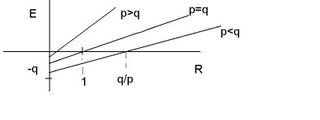
From this figure we can see that if p < q eg. p < 1/2, R the profit ratio has to be bigger than 1 and even bigger than q/p for the expectancy to become positive. When p > 1/2, R also equals q/p but because in this case the ratio q/p is less than 1, a positive expectancy can be expected sooner, eg. with a smaller profit loss ratio.
The figure also gives how big q/p has to be for a system with a positive expectancy for a given profit loss ratio R.
Another point which has to be made with relation to expectancy is that formula (1) for the expectancy is only an approximation for a real trading system. In a real live real tradingsystem we may expect many possible outcomes for a trade, positively or negatively, and each outcome with a different probability p. Let outcome X¡ with ¡= 1, 2 , 3 ..k and probability p¡.
The expectancy of this real live tradingsytem becomes more complicated and becomes:
ΣP¡X¡ /ΣP¡(X¡)^2
See for a formalism this article about Money management.
Another point to be made here is that returns, the outcomes of a system may not be normally distributed but oblique towards (hopefully!) positive returns. This may especially being the case when using a fixed stop. Such a distribution may be more precisely described as a Weibull distribution, an interesting point but beyond the scope of this posting.
I currently look at my returns with respect to a Weibull distribution. One of the nice things of this kind of representation is that a Weibull distribution has a surprisingly relatively simple calculus involved.
Systemtrading
Expectancy
We know that:
- E = P(w)W - P(l)L (1)
- where:
- E = expectancy
- P(w)= probability of a loss
- P(l)= probability of a win
- W = average win
- L = average loss.
Van Thorp uses in his analyses the expectancy per dollar risk, the expected return of a trade per dollar invested. He therefore divides E by the average loss L. Three examples may clear up the influences of the varying parameters involved.
I. Suppose an average win of 200 euro, an average loss of 100 euro, a win ratio of 0.75.
E becomes 0.75*200- 0.25*100 = 125 euro. Per euro risk is this 125/00 = 1.25
II. Now suppose the average loss two times as big, eg. 200 euro.
E = 0.75*200 - 0.25* 200 = 100, per euro risk of 1 euro.
III. Now we halve in our first example the average win to 100 euro.
E = 0.75*100 - 0.25* 100 = 50 euro, per euro risk 0.5 euro.
IV. Let p be increased with a factor of 15% eg p= 0.8625 in our first example.
E = 0.8625*200 - 0.1375*100 = 158.75 euro which is almost a double of increase for E.
With these examples we see that increasing the average win is more favourable for the expectancy and therefore the profability than decreasing the average loss, but also that increasing the win ratio proportional increasing the expectancy.
We can write Expectancy per euro risk as:
- E = pW -qL, off course p+q = 1
- E/L = (pW- qL)/L
- E/L = (p/L)*W -q/L*L
- E/L = pR - q (2)
- in which R= W/L the profit factor.
(2) Describes the expectancy per euro risk as a lineair function of R, so a line with slope p. When putting E = 0 (2) becomes:
0= pR - q , so R = q/p the intersection with the horizontal R axis and -q the intersection with the vertical E axis. See the figure below

From this figure we can see that if p < q eg. p < 1/2, R the profit ratio has to be bigger than 1 and even bigger than q/p for the expectancy to become positive. When p > 1/2, R also equals q/p but because in this case the ratio q/p is less than 1, a positive expectancy can be expected sooner, eg. with a smaller profit loss ratio.
The figure also gives how big q/p has to be for a system with a positive expectancy for a given profit loss ratio R.
Another point which has to be made with relation to expectancy is that formula (1) for the expectancy is only an approximation for a real trading system. In a real live real tradingsystem we may expect many possible outcomes for a trade, positively or negatively, and each outcome with a different probability p. Let outcome X¡ with ¡= 1, 2 , 3 ..k and probability p¡.
The expectancy of this real live tradingsytem becomes more complicated and becomes:
ΣP¡X¡ /ΣP¡(X¡)^2
See for a formalism this article about Money management.
Another point to be made here is that returns, the outcomes of a system may not be normally distributed but oblique towards (hopefully!) positive returns. This may especially being the case when using a fixed stop. Such a distribution may be more precisely described as a Weibull distribution, an interesting point but beyond the scope of this posting.
I currently look at my returns with respect to a Weibull distribution. One of the nice things of this kind of representation is that a Weibull distribution has a surprisingly relatively simple calculus involved.
Systemtrading
Expectancy
Kamis, 18 Mei 2006
A REVEARSAL CHART PATTERN
Markets clearly topping off the last days,as expecting in my post 'The end of Trends' , almost totally correct the rise of this year. You can see this in the chart of the S&P500 , the Dow Jones and the German FDAX.
Chart patterns can be very usefull, but are not easily recognised immediatelly. It is allways easy to see a top revearsal afterwards as shown in a post of Stepan Vita. He describes a classical top pattern in the chart of Toll Brothers (TOL). You can see a Shoulder, Head Shoulder (HSH) pattern and also a black cross. Now this is recognised at the moment when most of the correction of last years bullish trend has been done, but off course difficult to predict in an earlier stage, eg after the HSH patten occured.
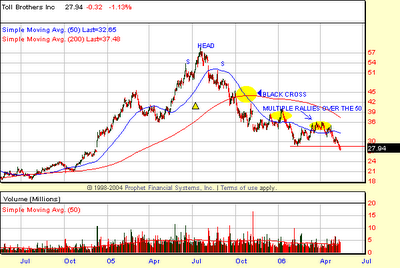
Chart patterns can be very usefull, but are not easily recognised immediatelly. It is allways easy to see a top revearsal afterwards as shown in a post of Stepan Vita. He describes a classical top pattern in the chart of Toll Brothers (TOL). You can see a Shoulder, Head Shoulder (HSH) pattern and also a black cross. Now this is recognised at the moment when most of the correction of last years bullish trend has been done, but off course difficult to predict in an earlier stage, eg after the HSH patten occured.

Rabu, 17 Mei 2006
Reducing Your Unsecured Debt
A recent survey showed that more than 2 million people in the
UK had unsecured debt of more than £10,000 (approximately
$16,000). As you can imagine most of this debt is held on Store
and Credit Cards, which are quite often the most expensive form
of unsecured debt an individual can acquire.
How manageable this debt is, is often down to the individual's
circumstances. One thing for sure is that when borrowing you
want to aim to reduce the amount of interest that you pay on
any outstanding debt. Here are a few tips to achieve this.
1. Pay off expensive debt first
Unsecured lending is by far the most expensive borrowing and if
you have a number of cards, some probably charge higher interest
rates than others. If you are not paying off the full balance of
your credit card each month, aim to pay more off the most
expensive cards.
2. Transfer expensive debt to cheaper cards
There's a lot of competition out there. Many credit cards have
introductory offers with either low or zero interest rates.
Transfer your balances from your old card to these new cards.
Remember to close your old credit card accounts to remove
temptation. It is a well known fact that many people don't
close their old accounts and then rack up more debt on both the
old and new accounts.
3. When you've cleared some debt, try not to borrow more
When you've cleared your credit card balances, try to get into
the habit of only spending what you earn. Stop using the cards
and to remove temptation cut them up. It pays to disciplined.
Remember you're trying to reduce debt. The best thing to do is
to create a budget for yourself and pay for everything with
cash.
Obviously this isn't an exhaustive list, but if you follow
these tips it will be a positive move in the right direction.
About The Author: Ian Walsh is the webmaster at
http://www.samuelblanksonbooks.info, information on Finance,
Gambling and Self-Help.
UK had unsecured debt of more than £10,000 (approximately
$16,000). As you can imagine most of this debt is held on Store
and Credit Cards, which are quite often the most expensive form
of unsecured debt an individual can acquire.
How manageable this debt is, is often down to the individual's
circumstances. One thing for sure is that when borrowing you
want to aim to reduce the amount of interest that you pay on
any outstanding debt. Here are a few tips to achieve this.
1. Pay off expensive debt first
Unsecured lending is by far the most expensive borrowing and if
you have a number of cards, some probably charge higher interest
rates than others. If you are not paying off the full balance of
your credit card each month, aim to pay more off the most
expensive cards.
2. Transfer expensive debt to cheaper cards
There's a lot of competition out there. Many credit cards have
introductory offers with either low or zero interest rates.
Transfer your balances from your old card to these new cards.
Remember to close your old credit card accounts to remove
temptation. It is a well known fact that many people don't
close their old accounts and then rack up more debt on both the
old and new accounts.
3. When you've cleared some debt, try not to borrow more
When you've cleared your credit card balances, try to get into
the habit of only spending what you earn. Stop using the cards
and to remove temptation cut them up. It pays to disciplined.
Remember you're trying to reduce debt. The best thing to do is
to create a budget for yourself and pay for everything with
cash.
Obviously this isn't an exhaustive list, but if you follow
these tips it will be a positive move in the right direction.
About The Author: Ian Walsh is the webmaster at
http://www.samuelblanksonbooks.info, information on Finance,
Gambling and Self-Help.
Credit Card Debt Statistics
In the United States, the debt levels of Americans have
continued to increase since the 1980s. It was during this time
that the use of credit cards greatly increased. Credit cards
companies begin looking for different ways to market their
products to consumers, and used such things as direct mail,
commercials, and other marketing tactics.
It was during the 1980s that consumers begin moving away from
cash and checks into credit cards. The cause of this is often
attributed to the start of the information age. As the use of
computers became more widespread, credit cards quickly
followed. It is estimated that the number of people using
credit cards during this time surpassed those who were using
checks and cash in a single year. The use of debit cards has
grown tremendously since this time as well.
The rise of debit cards are a direct result of the problems
seen with using credit cards. Statistics show that the average
American consumer owes about $9,000 in credit card debt. Many
people have made the mistake of thinking that they are using
their own money when they use credit cards to make purchases.
It is easy to forget that this money is owned by the credit
card companies, and they are simply allowing you to borrow it,
with the promise you will pay it back. The average interest
rate owed on credit cards in the US is about 14%.
It is easy to view credit cards as being "easy money." After
all, you don't have to work for it, and it doesn't have the
same effect on you that cash has. Statistics show that people
have a tendency to spend the money of others much faster than
their own. Recent data also shows that Americans are paying
even less of their debts than ever before. It was recently on
the news that the savings rate for Americans is negative, at
about -0.05%.
Though we live in an electronic age, being irresponsible with
your credit cards is a great way to end up with a life time of
headaches. Many high quality jobs now require you to have good
credit, and it is difficult to get a mortgage or a car if you
have poor credit. This is why it pays to be responsible with
how you manage your finances. It is best to stop borrowing
money and use your own funds to make purchases.
About The Author: Joe Kenny writes for the credit card
comparison sites http://www.creditcards121.com and also
http://www.cardguide.co.uk
Please use the HTML version of this article at:
http://www.isnare.com/html.php?aid=49169
continued to increase since the 1980s. It was during this time
that the use of credit cards greatly increased. Credit cards
companies begin looking for different ways to market their
products to consumers, and used such things as direct mail,
commercials, and other marketing tactics.
It was during the 1980s that consumers begin moving away from
cash and checks into credit cards. The cause of this is often
attributed to the start of the information age. As the use of
computers became more widespread, credit cards quickly
followed. It is estimated that the number of people using
credit cards during this time surpassed those who were using
checks and cash in a single year. The use of debit cards has
grown tremendously since this time as well.
The rise of debit cards are a direct result of the problems
seen with using credit cards. Statistics show that the average
American consumer owes about $9,000 in credit card debt. Many
people have made the mistake of thinking that they are using
their own money when they use credit cards to make purchases.
It is easy to forget that this money is owned by the credit
card companies, and they are simply allowing you to borrow it,
with the promise you will pay it back. The average interest
rate owed on credit cards in the US is about 14%.
It is easy to view credit cards as being "easy money." After
all, you don't have to work for it, and it doesn't have the
same effect on you that cash has. Statistics show that people
have a tendency to spend the money of others much faster than
their own. Recent data also shows that Americans are paying
even less of their debts than ever before. It was recently on
the news that the savings rate for Americans is negative, at
about -0.05%.
Though we live in an electronic age, being irresponsible with
your credit cards is a great way to end up with a life time of
headaches. Many high quality jobs now require you to have good
credit, and it is difficult to get a mortgage or a car if you
have poor credit. This is why it pays to be responsible with
how you manage your finances. It is best to stop borrowing
money and use your own funds to make purchases.
About The Author: Joe Kenny writes for the credit card
comparison sites http://www.creditcards121.com and also
http://www.cardguide.co.uk
Please use the HTML version of this article at:
http://www.isnare.com/html.php?aid=49169
Selasa, 16 Mei 2006
RANDOM WALK, GAMBLING AND TRADING
Physical problems are sometimes modelled as random walks, sometimes also called a "drunkard's walk". In this model many successive steps are taken, but each in a random direction. The direction of each step being independant of the direction of the previous one.
A famous example is the Brownian motion of a smoke particle in very dilute gas. The invisible gasmolecules colliding at random against the, in comparison to the molecules, very big smoke particle. In two dimensions a random walk can be seen in the figure below.
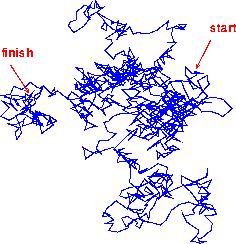
Random walk of 1000 steps
Random walks have serious implications for probabilty events. When throwing a fair coin, you know the chance of a head equals the chance of a tail (50:50 or p= 1/2). But what are possible outcomes when throwing a fair coin? Suppose the coin did come with a streak of 6 tails in a row? What is the chance of the next throw also being a tail? The chance of another tail is just 1/2 independant of the foregoing outcome.
Many people intuitively assume that after a series of consequtive tails a head must show up with greater certainty. There are many examples of this assumption of what is called the expectation a regression to the mean.
Last night I watched on television a pokergame (Texas Hold'em at the Poker Den organised by PartyPoker.com). There was this beautifull young lady getting bad cards al night and the commentators just outbursted that it is not possible to get bad cards forever, she had to get good cards at last: she played out without getting a picture and only a few hands played.
The man in the casino watching slot machines which didnot pay out for a long time is also an example of an expection for a regression to the mean. Casino's know this too well and just let the slot machines produce random numbers so the next outcome is independant of the previous one: a losing game by all means, the edge is to the house, the chance of a win is smaller than 1/2.
But let's return to a coin. I found an astonishing picture in A Guide To Gambling, Love, The Stock Market & And About Everything Else, a book I noted before.
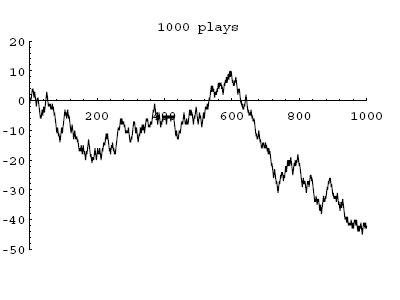
The graph shows the result of a computer-simulated sequence of thousend thosses of a fair coin, eacch time a head is coming up it adds up +1 and when a tail comes up-1. You feel since the probability of each result, tail or head, is equal, here should be as may heads as tails after a certain time.
Now this is true but only after a very long time, in fact after infinite time. Over the short term, which may relatively long periods, more heads than tails occur and vice versa. This supposes very long lasted unexpected streaks of either tails or heads. This is the random walk of a coin.
There is a formula for the probability of a streak:
For an explanation and an example see winning and losing streaks.
We return to our activities on the stockmarket. Market prices are sometimes also considered as random walks (especially as the outcome a of classical price theories). In a way we could see in graph above the movement of a stock price (or future or whatever) in time.
In an earlier posting I gave a distribution of one day and 5 days returns on the GBP/USD. Clearly these distributions are not random: it resembles more of a normal distribution around a mean. Whatever it is, the movements in a much smaller timeframe, eg ticks, could still be a random walk. Maybe the duration in which the one day and 5 day returns are gathered is just to small to reject a random walk.
In approximation the distance R² from a starting point in a random walk to the end point is proportional to N in which N is total of steps:
R² = N*r
(2)
r is the square root of the average squared step size or root mean squared step size. If I take r as a tick on the FDAX and normalise to 1 formula (2)becomes:
R² = N.
and R is epresssed in ticks.
(followed)
Systemtrading
gambling and trading
A famous example is the Brownian motion of a smoke particle in very dilute gas. The invisible gasmolecules colliding at random against the, in comparison to the molecules, very big smoke particle. In two dimensions a random walk can be seen in the figure below.

Random walk of 1000 steps
Random walks have serious implications for probabilty events. When throwing a fair coin, you know the chance of a head equals the chance of a tail (50:50 or p= 1/2). But what are possible outcomes when throwing a fair coin? Suppose the coin did come with a streak of 6 tails in a row? What is the chance of the next throw also being a tail? The chance of another tail is just 1/2 independant of the foregoing outcome.
Many people intuitively assume that after a series of consequtive tails a head must show up with greater certainty. There are many examples of this assumption of what is called the expectation a regression to the mean.
Last night I watched on television a pokergame (Texas Hold'em at the Poker Den organised by PartyPoker.com). There was this beautifull young lady getting bad cards al night and the commentators just outbursted that it is not possible to get bad cards forever, she had to get good cards at last: she played out without getting a picture and only a few hands played.
The man in the casino watching slot machines which didnot pay out for a long time is also an example of an expection for a regression to the mean. Casino's know this too well and just let the slot machines produce random numbers so the next outcome is independant of the previous one: a losing game by all means, the edge is to the house, the chance of a win is smaller than 1/2.
But let's return to a coin. I found an astonishing picture in A Guide To Gambling, Love, The Stock Market & And About Everything Else, a book I noted before.

The graph shows the result of a computer-simulated sequence of thousend thosses of a fair coin, eacch time a head is coming up it adds up +1 and when a tail comes up-1. You feel since the probability of each result, tail or head, is equal, here should be as may heads as tails after a certain time.
Now this is true but only after a very long time, in fact after infinite time. Over the short term, which may relatively long periods, more heads than tails occur and vice versa. This supposes very long lasted unexpected streaks of either tails or heads. This is the random walk of a coin.
There is a formula for the probability of a streak:
- q = [1+(n-r) p]q' (1)
- n = amount of tosses (trades!)
- r = losing streak
- p = chance of a single outcome
- q' = P^r (power r)
For an explanation and an example see winning and losing streaks.
We return to our activities on the stockmarket. Market prices are sometimes also considered as random walks (especially as the outcome a of classical price theories). In a way we could see in graph above the movement of a stock price (or future or whatever) in time.
In an earlier posting I gave a distribution of one day and 5 days returns on the GBP/USD. Clearly these distributions are not random: it resembles more of a normal distribution around a mean. Whatever it is, the movements in a much smaller timeframe, eg ticks, could still be a random walk. Maybe the duration in which the one day and 5 day returns are gathered is just to small to reject a random walk.
In approximation the distance R² from a starting point in a random walk to the end point is proportional to N in which N is total of steps:
R² = N*r
(2)
r is the square root of the average squared step size or root mean squared step size. If I take r as a tick on the FDAX and normalise to 1 formula (2)becomes:
R² = N.
and R is epresssed in ticks.
(followed)
Systemtrading
gambling and trading
Minggu, 14 Mei 2006
THE END OF TRENDS?
Trends do end in any given timeframe. We saw on the last two days what maybe an end of this years strong bull trend, although it may not be over yet.
I was thinking of this when reading Paolo Pezzutti's posting what Mr. Buffet warnes about speculation and and the investments of the public. I cite his posting:
"The price of metals, such as copper, and other commodities like oil, initially climbed on fundamentals, but the gains have now attracted more investors betting on further price gains, he explained. “What the wise man does at the beginning the fool does at the end,” he quipped. “Once a price history develops enough for other people to see it and get envious, that takes over markets. We’re seeing that some areas of the commodity markets.” "
"Selling in may and go away" be the right thing to now. The DOW still in it's trend but the broader markets aren't. See charts below, click for a full screen.

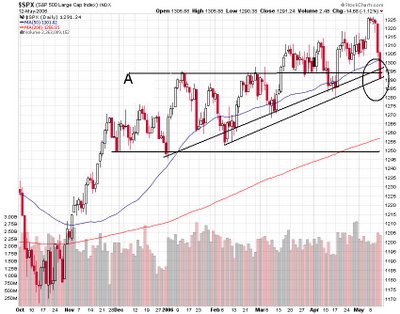
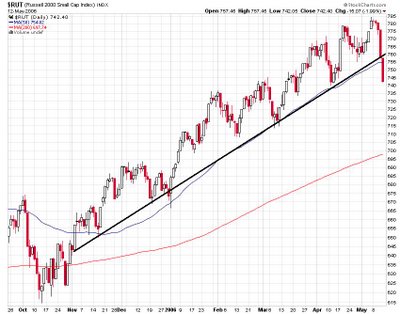
Systemtrading
Dow Jones
trends
I was thinking of this when reading Paolo Pezzutti's posting what Mr. Buffet warnes about speculation and and the investments of the public. I cite his posting:
"The price of metals, such as copper, and other commodities like oil, initially climbed on fundamentals, but the gains have now attracted more investors betting on further price gains, he explained. “What the wise man does at the beginning the fool does at the end,” he quipped. “Once a price history develops enough for other people to see it and get envious, that takes over markets. We’re seeing that some areas of the commodity markets.” "
"Selling in may and go away" be the right thing to now. The DOW still in it's trend but the broader markets aren't. See charts below, click for a full screen.
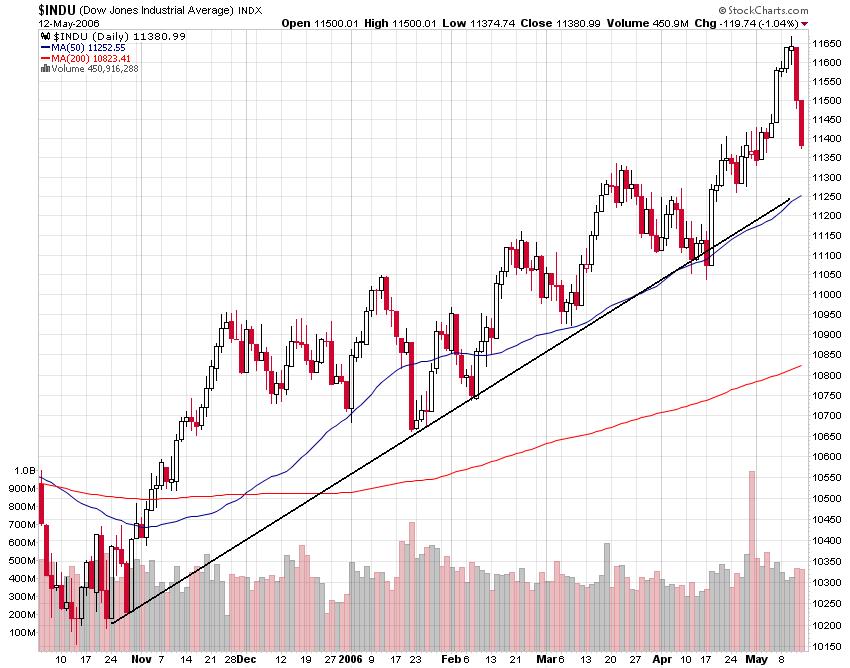
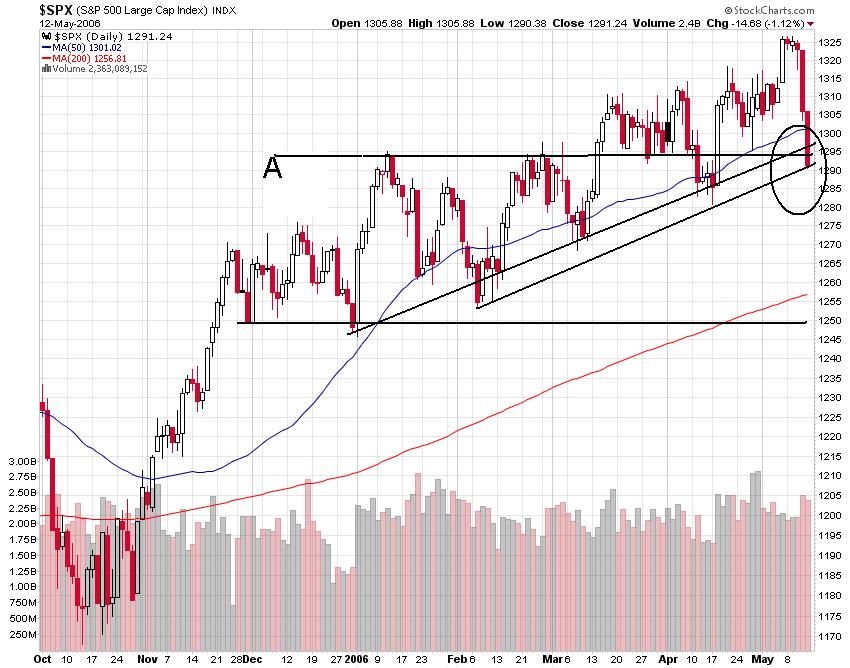

Systemtrading
Dow Jones
trends
Kamis, 11 Mei 2006
TRADES AND MARKET MOVEMENTS
After a couple of days I was finally able today to place some orders on the FDAX and on the DOW future.
What was the reason for not trading? Well, the market did not came up with my favourable setups but just trended upwards very strongly, every position would be unsecure. We have to see if the market wil revearse from here for a more longer time or just a blow off after FED's decision and suggestions about further interest rates.
Joao and fernando of Hello Dax, a blog on which I am invited to write something about futures, propose a setup for a winning option strategy on the DAX. I have some doubts about this.
Movements on markets are not linear as they suppose to assume but rather random walks, certainly in the short and middle long time span. Markets move in a jagged fashion which may be demonstrated by comparing distributions of returns over various time periods. Just look at the graphs below.
The fact that the range of the 5-day distribution is nowhere near five times the width of the 1-day distribution (in terms of max to min) tells you the market
almost never moves directly from point A to point B. Off course this is a valuta index but you may expect this being the case for stock indices too. Options are very susceptiable for such movements.
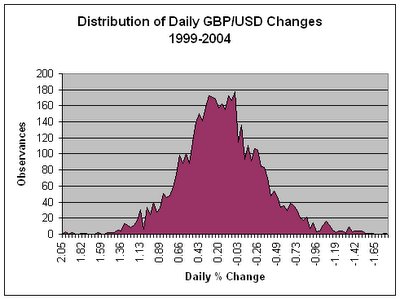
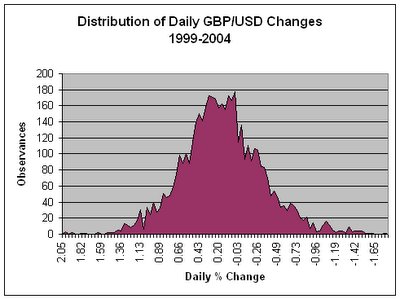
Dow Jones
FDAX
Systemtrading
What was the reason for not trading? Well, the market did not came up with my favourable setups but just trended upwards very strongly, every position would be unsecure. We have to see if the market wil revearse from here for a more longer time or just a blow off after FED's decision and suggestions about further interest rates.
Joao and fernando of Hello Dax, a blog on which I am invited to write something about futures, propose a setup for a winning option strategy on the DAX. I have some doubts about this.
Movements on markets are not linear as they suppose to assume but rather random walks, certainly in the short and middle long time span. Markets move in a jagged fashion which may be demonstrated by comparing distributions of returns over various time periods. Just look at the graphs below.
The fact that the range of the 5-day distribution is nowhere near five times the width of the 1-day distribution (in terms of max to min) tells you the market
almost never moves directly from point A to point B. Off course this is a valuta index but you may expect this being the case for stock indices too. Options are very susceptiable for such movements.
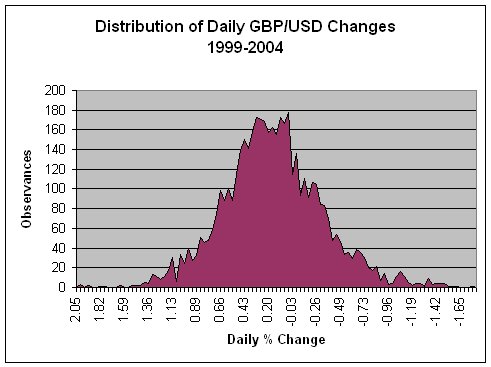
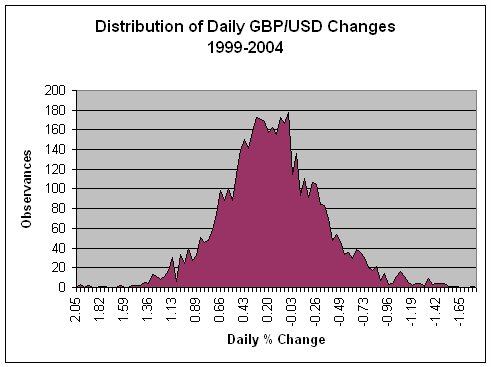
Dow Jones
FDAX
Systemtrading
Rabu, 10 Mei 2006
BEARS: ALLWAYS UP ?
Fridays outbreak at the markets must be something of a killer for the bears as Stephan Vita notes on his blog. They may think they are right and the markets wrong..The Dow Jones tries to hit all time high, attracted by it like a magnet.
See chart of the Dow since 1935. Allways good to see and now you know why our queen became so rich.
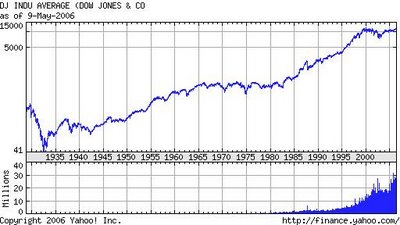
The European indices still some 25 to 30 % away from the highs of 2000, so they have a long way to go. See chart of the Dax since 1990.
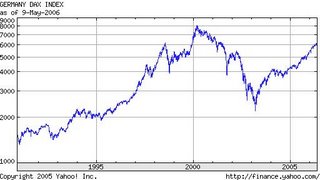
Dow Jones
FDAX
See chart of the Dow since 1935. Allways good to see and now you know why our queen became so rich.

The European indices still some 25 to 30 % away from the highs of 2000, so they have a long way to go. See chart of the Dax since 1990.

Dow Jones
FDAX
Senin, 08 Mei 2006
MARKETS UPDATE
Both the S&P 500 and the Dow Jones closing to year highs eploring new territories as you can see in the charts. The broader Russel 2000 (symbol: $RUT) at all time high. We cannot go up forever, what are the underlying reasons for these uptrends? I don't know and it doesnot bother me either. I do know we will correct someday, but not now.
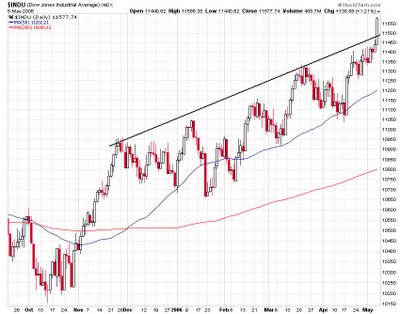
Dow Jones
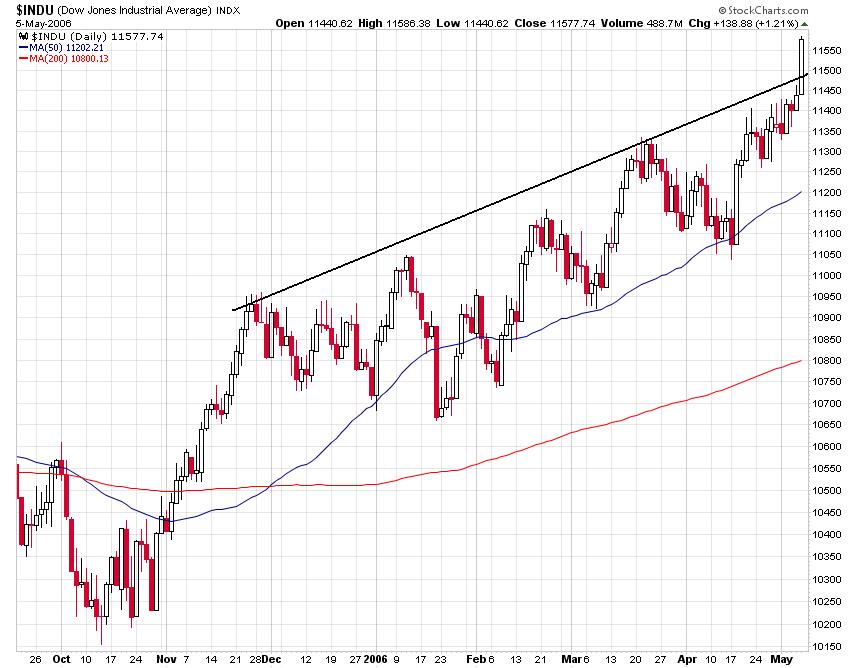
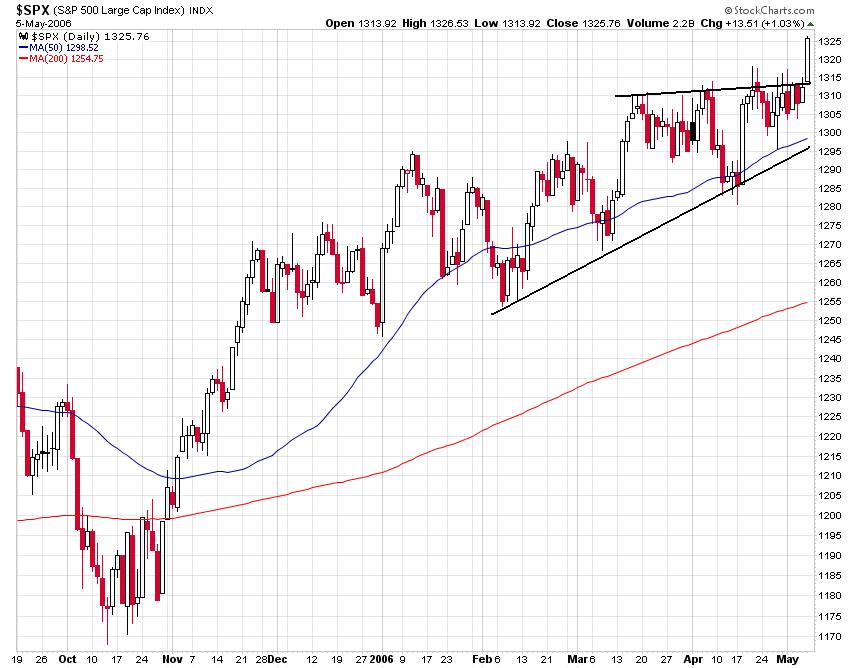
Dow Jones
Kamis, 04 Mei 2006
DOW JONES UPDATE
The last days the Dow Jones wrestling with the 11400 level. Let us see if it can stay above this level maybe testing the upper trend line today. See chart.
Dow Jones
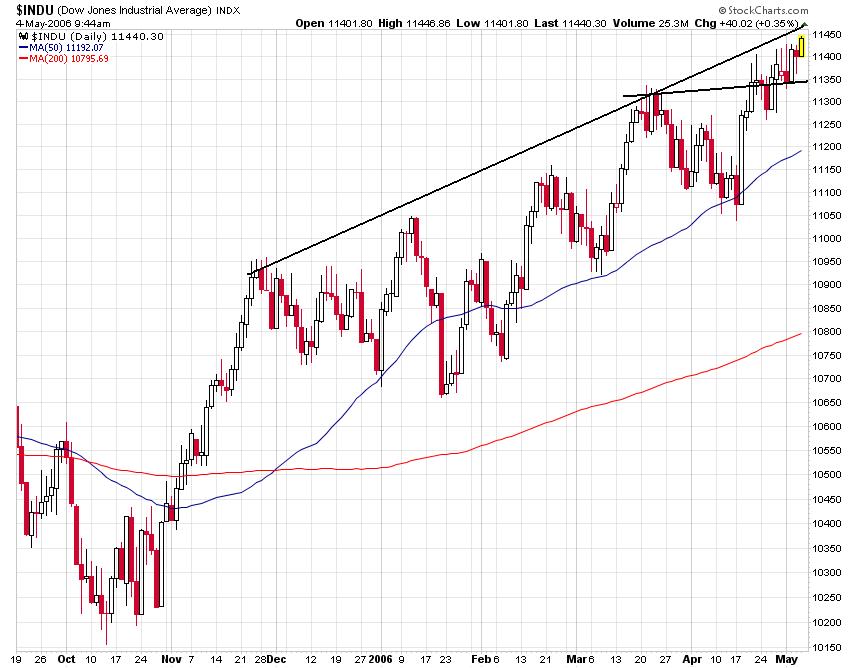
Dow Jones
DISCIPLINE AND MISSING THE BIG ONE
Discipline has many faces when it becomes to trading. Earlier I gave the doubts and visions of globetrader. Now the word is to Victor Niederhoffer himself taken from his website. Later on I will give my experiences. He describes the subject of stubborness of traders, a must be killer to a trader. Never ever be stubborn in your vision when markets are against you. It is good to have a vision in general but never fight against the market, because you wil lose. Remember markets and trading is not of being right but of making money.
Comparing the battle between some passengers taking his bus with the operator due to possible delay and gamblers completely losing their senses in attempt not to miss even one chance.:
"....and that the remaining passengers, who were involved in a screaming battle with the bus operator over possible delay in getting to the track on time were more typical. This remnant certainly suffered from the tendency of all gamblers to completely lose their sense of balance and priorities in a desperate attempt not to miss even one chance to get even"
Traders inevitably allways see comparisons with their trading activities but this one surely being a surprising one and funny too.
He goes on:
"I once had a client from the Mediterranean who insisted on selling the stock market futures short whenever it set a five-day low. He lost about 20 times in a row after 1987 and I advised him to take a break. "I can't. The big crash might come while I was away." he said."
And than off course romance comes into play:
"remember Artie's telling me that one of his best friends missed his wedding and never married because he got into a card game on a train going to his own wedding"
I admire Niederhoffers style and the surprising turns his articles take, sometimes long-winded but allways pointing to trading and the markets.
So stubbornness and losing sense of balance leading a trader to disaster.
There is another aspect which is as deadly as those mentioned: addiction to trading. In a comment (Jared Albert) puts his experiences:
"..the anxiety of watching the market rebound and being unable to trade was unbearable and eventually he'd have to take the phones to work with him after a losing streak. Luckily I wiped out 3 times in 6 years and discovered that the pain of having no steak is worse than the pain of missed opportunities."
"The issue of compulsive trading or trading for excitement are clearly among the most dangerous."
Now misssing the big one or addiction to trading being totally different from problems whith missing some good opportunities that can arise by various reasons as abstinence or pulling the trigger fear. I wrote earlier about missing trades.
Systemtrading
Comparing the battle between some passengers taking his bus with the operator due to possible delay and gamblers completely losing their senses in attempt not to miss even one chance.:
"....and that the remaining passengers, who were involved in a screaming battle with the bus operator over possible delay in getting to the track on time were more typical. This remnant certainly suffered from the tendency of all gamblers to completely lose their sense of balance and priorities in a desperate attempt not to miss even one chance to get even"
Traders inevitably allways see comparisons with their trading activities but this one surely being a surprising one and funny too.
He goes on:
"I once had a client from the Mediterranean who insisted on selling the stock market futures short whenever it set a five-day low. He lost about 20 times in a row after 1987 and I advised him to take a break. "I can't. The big crash might come while I was away." he said."
And than off course romance comes into play:
"remember Artie's telling me that one of his best friends missed his wedding and never married because he got into a card game on a train going to his own wedding"
I admire Niederhoffers style and the surprising turns his articles take, sometimes long-winded but allways pointing to trading and the markets.
So stubbornness and losing sense of balance leading a trader to disaster.
There is another aspect which is as deadly as those mentioned: addiction to trading. In a comment (Jared Albert) puts his experiences:
"..the anxiety of watching the market rebound and being unable to trade was unbearable and eventually he'd have to take the phones to work with him after a losing streak. Luckily I wiped out 3 times in 6 years and discovered that the pain of having no steak is worse than the pain of missed opportunities."
"The issue of compulsive trading or trading for excitement are clearly among the most dangerous."
Now misssing the big one or addiction to trading being totally different from problems whith missing some good opportunities that can arise by various reasons as abstinence or pulling the trigger fear. I wrote earlier about missing trades.
Systemtrading
Senin, 01 Mei 2006
DISCIPLINE WITH TRADING
Yesterday Globetrader added an interesting posting about discipline in trading. He compares it with stopping with chocolate. He used yesterdays holiday to investigate this aspect on his trading and studied the patterns when losing his discipline.
Some quotations made by him:
"You have an edge, you have your good winning streaks, but somehow the losers still take care of them and at the end of the month, at the end of the quarter you have retraced back to zero."
"Be it one or two exceptionell big losers, because everything you’ve learned the last few years goes overboard, in this moment, or be it a streak, where nothing you do seems to work, where you get signal after signal and they all get stopped out."
He admits to be in the first category:
"I’m in the first category, I blew it all in 1 or 2 exceptionell bad trades, sit there, look at me, tell me “oh shit Chris, you did it again”."
And:
"I know I can, I know I have an edge, I trust myself and I’m (usually) not trigger shy. But I have these whipsaw trades coming now and then, which take care of a good chunk of my profits."
I find this very brave to admit because I know he is true.
More about trading and discipline:
Some quotations made by him:
"You have an edge, you have your good winning streaks, but somehow the losers still take care of them and at the end of the month, at the end of the quarter you have retraced back to zero."
"Be it one or two exceptionell big losers, because everything you’ve learned the last few years goes overboard, in this moment, or be it a streak, where nothing you do seems to work, where you get signal after signal and they all get stopped out."
He admits to be in the first category:
"I’m in the first category, I blew it all in 1 or 2 exceptionell bad trades, sit there, look at me, tell me “oh shit Chris, you did it again”."
And:
"I know I can, I know I have an edge, I trust myself and I’m (usually) not trigger shy. But I have these whipsaw trades coming now and then, which take care of a good chunk of my profits."
I find this very brave to admit because I know he is true.
More about trading and discipline:
Kamis, 27 April 2006
TRENDLINES
I don't use trendlines very often, I prefer moving averages, eg. 50 SMA to depict a trend. Trendlines often being to subjective, but in the chart of the Dow Jones it can be seen how usefull trend lines can be.
The chart of the S&P 500 is not so clear. Alhough the index being up this year, there is a broader feeling amongst traders the markets not doing very well. How does this come?
First, lt's see the charts of the Dow and the S&P, both probably taking today a breazer.

This broader sense of markets going nowhere can be understood if you look at stocks moving above or below their 50 SMA's. The ratio just moving in a range of 350 and 225 since a few monts so going sideways, on average the amount of stocks moving above their 50 SMA is not increasing and I suppose this being responsible for the general feeling by some these days.

Systemtrading
Dow Jones
trends
The chart of the S&P 500 is not so clear. Alhough the index being up this year, there is a broader feeling amongst traders the markets not doing very well. How does this come?
First, lt's see the charts of the Dow and the S&P, both probably taking today a breazer.
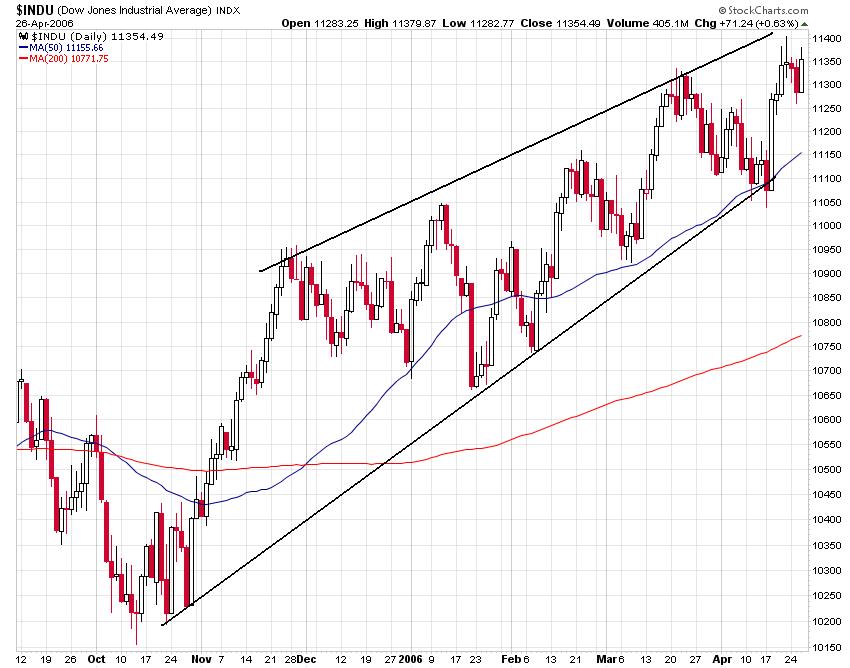
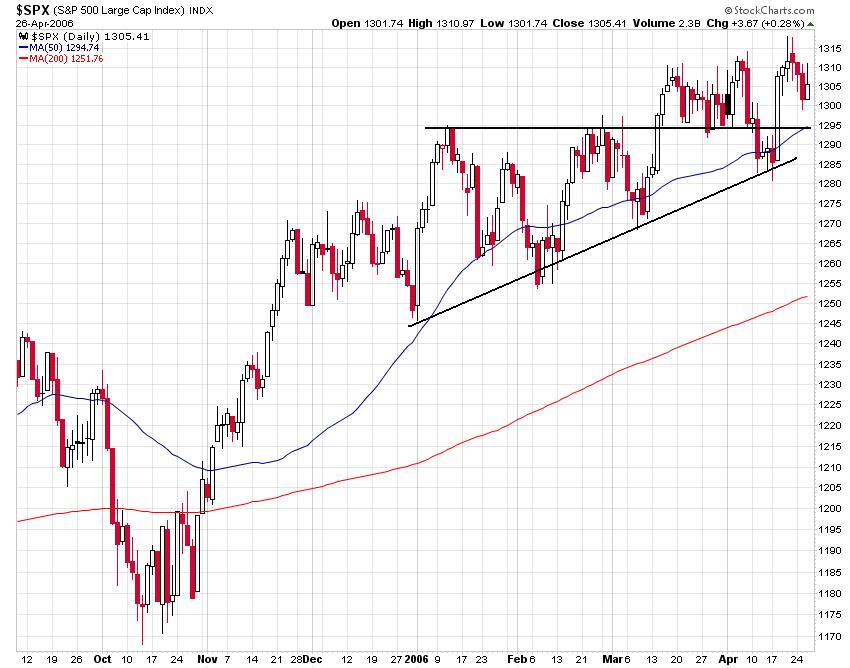
This broader sense of markets going nowhere can be understood if you look at stocks moving above or below their 50 SMA's. The ratio just moving in a range of 350 and 225 since a few monts so going sideways, on average the amount of stocks moving above their 50 SMA is not increasing and I suppose this being responsible for the general feeling by some these days.
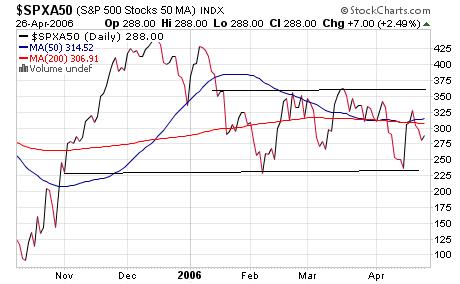
Systemtrading
Dow Jones
trends
Selasa, 25 April 2006
What Is A Judgment Lien?
A judgment lien is a court ordered lien that is placed against
the home or property when the homeowner simply fails to pay a
debt. This doesn't seem like a big deal, but when the homeowner
has a judgment lien against his or her home and wants to sell
it, the judgment lien has to be paid in full before the home or
property can be sold. Judgment liens can be placed against the
property for a variety of reasons such as unpaid credit card
bills, utility bills, department store bills, landscaping or
home improvement bills, and just about any bill that the
homeowner has failed to pay in a reasonable amount of time. Any
bill that can cause one to end up in court can result in a
judgment lien.
A judgment lien is different than a trust, in that the judgment
lien holder cannot foreclose on the home or the property as
trust holder can. Judgment lien holders can demand payment, but
ultimately they must wait for the homeowner to sell the property
before they can expect to be paid the money that they are owed
according to the judgment. Luckily for the judgment lien
holder, the court will typically assign an interest rate to
these liens so that the lien holder is compensated for their
waiting as the interest will continue to accrue until the debt
is paid in full. Because the majority of people will live in
their home for quite some time, the interest can make a
judgment lien grow, and grow, and grow over the years so that
it is quite large. Imagine what a lien of just $3,000 would
grow to over the years if the interest rate were 15% annually
and that would be an even bigger amount if the debt were $5,000
or $10,000!
Of course, judgment liens require court action. A creditor will
take the homeowner to court where the judge will determine if
the homeowner does in fact owe the creditor any money. If the
court decides that the creditor is owed the money, and the
homeowner will not or cannot make payment, the judge will order
that a judgment lien be placed against the property. The
judgment lien will then be entered into land records offices
for the city or county so that the home cannot be sold without
repayment of the debt. Once the lien is filed with the land
records office, the judgment lien is said to be attached to the
property, meaning that it cannot legally be sold without paying
off that lien. If the judgment lien is not listed at the land
records office, then it means that the debt or lien is not
legally attached to the property and does not need to be paid
off to sell the home.
A home or property can have numerous liens against it, which
may present a problem when the home is to be sold. Fortunately,
the law says that liens will be paid off in the order that they
were attached to the property, meaning the first lien will be
paid first, the second will be paid second, and so on. This is
a law that was basically developed for when a home is
foreclosed on. If a foreclosed home is auctioned it will first
pay off the first lien, then the second, and the third until
there is no money left to pay the debts that are still attached
or associated with the home. Of course, all trusts against the
house, such as mortgages and home equity loans, would be paid
off before the judgment liens, so it's not uncommon for these
liens to simply go unpaid because there is no money remaining
to pay these debts after the trusts are paid. If there is not
enough money to pay for all of the judgment liens and trusts on
the home or property, they are then wiped out and can no longer
be collected on. Of course, the auction will usually attempt to
pay for all of these debts, and they are paid for until there is
no money. The reason for this is that the new owner will not be
able to get any home equity loans or second mortgages with
judgment liens already on the home. If there is money left over
after everything is paid off, the remaining amount would go to
the foreclosed homeowner as all debts are paid.
You can look for judgment liens at the land records office,
though you will typically not find them listed with trusts.
Investors or homeowners looking to sell their home will have to
look into both trusts and judgments, as they are listed in
different areas. Investors can often be caught off guard when
they realize how much debt is attached to the home, and sellers
are often startled at old judgment liens that they had forgotten
about and don't want to afford to pay off in order to sell their
home. It's a good idea to go over all of this information before
one bids on a home or attempts to sell it or put it on the
market.
Judgment liens are not something that anyone wants put against
their home, but they are common enough. There comes a time for
many people when they simply cannot pay a bill, and a judgment
lien is ordered. Making a continued effort to pay down the debt
is a great idea so that you don't acquire large interest fees in
addition to the initial dollar amount of the lien. The homeowner
does not have to wait until the home is sold to pay off the
lien, instead they can be paid off as soon as possible. The
judgment lien is simply put in place so that the home cannot be
sold without the debt being paid, and when you look at it from
the creditors point of view, this is a great tool to ensure
that you'll eventually be paid the amount you are owed in
addition to an interest fee that will pay you for waiting.
About The Author: Visit http://www.theforeclosuresinfo.com and
http://www.stateof-california.com
Please use the HTML version of this article at:
http://www.isnare.com/html.php?aid=46104
the home or property when the homeowner simply fails to pay a
debt. This doesn't seem like a big deal, but when the homeowner
has a judgment lien against his or her home and wants to sell
it, the judgment lien has to be paid in full before the home or
property can be sold. Judgment liens can be placed against the
property for a variety of reasons such as unpaid credit card
bills, utility bills, department store bills, landscaping or
home improvement bills, and just about any bill that the
homeowner has failed to pay in a reasonable amount of time. Any
bill that can cause one to end up in court can result in a
judgment lien.
A judgment lien is different than a trust, in that the judgment
lien holder cannot foreclose on the home or the property as
trust holder can. Judgment lien holders can demand payment, but
ultimately they must wait for the homeowner to sell the property
before they can expect to be paid the money that they are owed
according to the judgment. Luckily for the judgment lien
holder, the court will typically assign an interest rate to
these liens so that the lien holder is compensated for their
waiting as the interest will continue to accrue until the debt
is paid in full. Because the majority of people will live in
their home for quite some time, the interest can make a
judgment lien grow, and grow, and grow over the years so that
it is quite large. Imagine what a lien of just $3,000 would
grow to over the years if the interest rate were 15% annually
and that would be an even bigger amount if the debt were $5,000
or $10,000!
Of course, judgment liens require court action. A creditor will
take the homeowner to court where the judge will determine if
the homeowner does in fact owe the creditor any money. If the
court decides that the creditor is owed the money, and the
homeowner will not or cannot make payment, the judge will order
that a judgment lien be placed against the property. The
judgment lien will then be entered into land records offices
for the city or county so that the home cannot be sold without
repayment of the debt. Once the lien is filed with the land
records office, the judgment lien is said to be attached to the
property, meaning that it cannot legally be sold without paying
off that lien. If the judgment lien is not listed at the land
records office, then it means that the debt or lien is not
legally attached to the property and does not need to be paid
off to sell the home.
A home or property can have numerous liens against it, which
may present a problem when the home is to be sold. Fortunately,
the law says that liens will be paid off in the order that they
were attached to the property, meaning the first lien will be
paid first, the second will be paid second, and so on. This is
a law that was basically developed for when a home is
foreclosed on. If a foreclosed home is auctioned it will first
pay off the first lien, then the second, and the third until
there is no money left to pay the debts that are still attached
or associated with the home. Of course, all trusts against the
house, such as mortgages and home equity loans, would be paid
off before the judgment liens, so it's not uncommon for these
liens to simply go unpaid because there is no money remaining
to pay these debts after the trusts are paid. If there is not
enough money to pay for all of the judgment liens and trusts on
the home or property, they are then wiped out and can no longer
be collected on. Of course, the auction will usually attempt to
pay for all of these debts, and they are paid for until there is
no money. The reason for this is that the new owner will not be
able to get any home equity loans or second mortgages with
judgment liens already on the home. If there is money left over
after everything is paid off, the remaining amount would go to
the foreclosed homeowner as all debts are paid.
You can look for judgment liens at the land records office,
though you will typically not find them listed with trusts.
Investors or homeowners looking to sell their home will have to
look into both trusts and judgments, as they are listed in
different areas. Investors can often be caught off guard when
they realize how much debt is attached to the home, and sellers
are often startled at old judgment liens that they had forgotten
about and don't want to afford to pay off in order to sell their
home. It's a good idea to go over all of this information before
one bids on a home or attempts to sell it or put it on the
market.
Judgment liens are not something that anyone wants put against
their home, but they are common enough. There comes a time for
many people when they simply cannot pay a bill, and a judgment
lien is ordered. Making a continued effort to pay down the debt
is a great idea so that you don't acquire large interest fees in
addition to the initial dollar amount of the lien. The homeowner
does not have to wait until the home is sold to pay off the
lien, instead they can be paid off as soon as possible. The
judgment lien is simply put in place so that the home cannot be
sold without the debt being paid, and when you look at it from
the creditors point of view, this is a great tool to ensure
that you'll eventually be paid the amount you are owed in
addition to an interest fee that will pay you for waiting.
About The Author: Visit http://www.theforeclosuresinfo.com and
http://www.stateof-california.com
Please use the HTML version of this article at:
http://www.isnare.com/html.php?aid=46104
Sabtu, 22 April 2006
Learn How To Fix Your Credit & Debt Problems Before Buying Your Next House!
Most people think - mistakenly - that if you have credit
problems, you have to wait 7 years for them to go away. Well,
that's not always true.
Credit repair can help you...once you know how to do it. The
time to clean up your credit and pay off your debts is RIGHT
NOW, before you start looking for houses and applying for
mortgages. Cleaning up your credit and lowering your debt will
help you:
. get a better interest rate
. borrow more money
. and save lots of money in interest
Clean Up Your Credit Report
These days, getting credit is easy. Unfortunately, so is
getting into debt or financial trouble.
But just because you've had some money problems does NOT mean
you can't get a mortgage and buy a house. There are all kinds
of loans:
. loans for first time homebuyers
. loans for people with bad credit
. loans for people with perfect credit
. and loans for people without a lot of money for a down
payment
So, most people can get a loan these days. The question is, HOW
MUCH will you pay in the long run for higher fees and interest
rates?
A lot of people think that if something bad goes on your credit
report, that it must stay there for 7 years, or longer. But
that's not always true. Credit repair can work, if you know how
to do it.
And, you can do it yourself.
For example, I had lots of debt (from a business idea that did
not work) and got a lot of bad credit listings while getting
myself out of debt.
And within 6 months of paying off my last credit card bill
(remember, even if you have some debt you might still be able
to get a house loan) I repaired my credit to the point that I
got both a car loan and a mortgage. More importantly, I got the
LOWEST POSSIBLE interest rates, which over the life of a 30-year
loan could save me tens of thousands of dollars!
How did I repair my credit?
I got a copy of all my credit reports, and kept writing letters
asking the credit bureaus to remove the bad credit.
So it CAN be done. (And I had some pretty bad stuff on my
credit reports.) The worst that can happen is that the credit
bureaus can say "no" to your request. The best that can happen
is that your credit score will improve, and you'll pay a lower
interest rate, get a bigger mortgage, or both!
So, how do you clean up your credit report?
The first step is to get a copy of your credit report from the
3 credit bureaus, listed below. You might have to pay a few
dollars, but it is well worth it. If you moved, changed jobs,
and had any other personal info change recently, you can send
it to the credit bureaus, and request a free copy.
NOTE: You are now entitled to one free credit report each year
from http://www.annualcreditreport.com.
The next step is to circle or highlight the bad credit items,
and write a letter to each credit bureau asking them to remove
the item. If you have a lot, focus on one or two at a time.
Then, wait a month or two, and ask for another one or two items
to be removed.
It might take a few tries.
But if you keep trying, eventually most (or all) of the items
will be removed.
In the worst case - even if you only get a few removed - it
might still improve your credit score, reduce your interest
rate, and lower your monthtly payment!
So don't give up.
It might take a little time to repair your credit - especially
if you've had quite a few money problems. But every little bit
helps your credit score, your interest rate, and the amount of
money you can get.
Then Pay Off As Much Debt As Possible
I know, when preparing to buy your new home money is real
tight. But if you have any extra money - any at all - try to
pay off as much debt as possible. This will help you:
. Be more likely to be approved for a mortgage
. Be able to borrow more money
. Have one (or more) less bill to worry about once you start
having to pay a mortgage every month.
If you can't pay off your debt, you might want to consider
waiting before buying your new home. Or, look into a debt
reduction program that can help you get out of debt faster.
There are no rules that say you can't have some debt and still
buy a house!
But think very carefully about your financial situation. And
TRY to pay off as much debt as possible before buying a house.
There is enough to worry about as a new homeowner, without
having to worry about paying your credit card bills.
At the very least, if you do have any debt, MAKE SURE you can
comfortably afford to pay your credit card bills as well as
your mortgage, before getting started!
About The Author: Kris Bickell is the owner of
HouseBuying-Tips.com, a site that helps first time home buyers
avoid the costly mistakes that many new homebuyers make. For
more tips on buying a house, getting a mortgage, finding a
realtor, and getting out of debt, sign up for the free "How To
Avoid These 10 Costly Mistakes When Buying Your First Home"
email course at: http://www.HouseBuying-Tips.com/course.html. ©
2005 HouseBuying-Tips.com
problems, you have to wait 7 years for them to go away. Well,
that's not always true.
Credit repair can help you...once you know how to do it. The
time to clean up your credit and pay off your debts is RIGHT
NOW, before you start looking for houses and applying for
mortgages. Cleaning up your credit and lowering your debt will
help you:
. get a better interest rate
. borrow more money
. and save lots of money in interest
Clean Up Your Credit Report
These days, getting credit is easy. Unfortunately, so is
getting into debt or financial trouble.
But just because you've had some money problems does NOT mean
you can't get a mortgage and buy a house. There are all kinds
of loans:
. loans for first time homebuyers
. loans for people with bad credit
. loans for people with perfect credit
. and loans for people without a lot of money for a down
payment
So, most people can get a loan these days. The question is, HOW
MUCH will you pay in the long run for higher fees and interest
rates?
A lot of people think that if something bad goes on your credit
report, that it must stay there for 7 years, or longer. But
that's not always true. Credit repair can work, if you know how
to do it.
And, you can do it yourself.
For example, I had lots of debt (from a business idea that did
not work) and got a lot of bad credit listings while getting
myself out of debt.
And within 6 months of paying off my last credit card bill
(remember, even if you have some debt you might still be able
to get a house loan) I repaired my credit to the point that I
got both a car loan and a mortgage. More importantly, I got the
LOWEST POSSIBLE interest rates, which over the life of a 30-year
loan could save me tens of thousands of dollars!
How did I repair my credit?
I got a copy of all my credit reports, and kept writing letters
asking the credit bureaus to remove the bad credit.
So it CAN be done. (And I had some pretty bad stuff on my
credit reports.) The worst that can happen is that the credit
bureaus can say "no" to your request. The best that can happen
is that your credit score will improve, and you'll pay a lower
interest rate, get a bigger mortgage, or both!
So, how do you clean up your credit report?
The first step is to get a copy of your credit report from the
3 credit bureaus, listed below. You might have to pay a few
dollars, but it is well worth it. If you moved, changed jobs,
and had any other personal info change recently, you can send
it to the credit bureaus, and request a free copy.
NOTE: You are now entitled to one free credit report each year
from http://www.annualcreditreport.com.
The next step is to circle or highlight the bad credit items,
and write a letter to each credit bureau asking them to remove
the item. If you have a lot, focus on one or two at a time.
Then, wait a month or two, and ask for another one or two items
to be removed.
It might take a few tries.
But if you keep trying, eventually most (or all) of the items
will be removed.
In the worst case - even if you only get a few removed - it
might still improve your credit score, reduce your interest
rate, and lower your monthtly payment!
So don't give up.
It might take a little time to repair your credit - especially
if you've had quite a few money problems. But every little bit
helps your credit score, your interest rate, and the amount of
money you can get.
Then Pay Off As Much Debt As Possible
I know, when preparing to buy your new home money is real
tight. But if you have any extra money - any at all - try to
pay off as much debt as possible. This will help you:
. Be more likely to be approved for a mortgage
. Be able to borrow more money
. Have one (or more) less bill to worry about once you start
having to pay a mortgage every month.
If you can't pay off your debt, you might want to consider
waiting before buying your new home. Or, look into a debt
reduction program that can help you get out of debt faster.
There are no rules that say you can't have some debt and still
buy a house!
But think very carefully about your financial situation. And
TRY to pay off as much debt as possible before buying a house.
There is enough to worry about as a new homeowner, without
having to worry about paying your credit card bills.
At the very least, if you do have any debt, MAKE SURE you can
comfortably afford to pay your credit card bills as well as
your mortgage, before getting started!
About The Author: Kris Bickell is the owner of
HouseBuying-Tips.com, a site that helps first time home buyers
avoid the costly mistakes that many new homebuyers make. For
more tips on buying a house, getting a mortgage, finding a
realtor, and getting out of debt, sign up for the free "How To
Avoid These 10 Costly Mistakes When Buying Your First Home"
email course at: http://www.HouseBuying-Tips.com/course.html. ©
2005 HouseBuying-Tips.com
Jumat, 21 April 2006
DOW TREND
The DOW seeking higher levels again. Now do you want a trend? See chart, the upperline coming into reach again, but I am not sure we will go that high immediately. Two nice Long trades in a row this week

Dow Jones
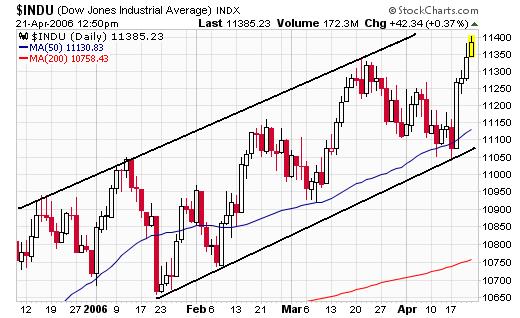
Dow Jones
Rabu, 19 April 2006
DOW JONES UPDATE
The DOW Jones is still in it's upward trend and found support at 11050 the last couple of days. It resulted in yesterdays big rise of almost 200 points with a small runaway gap in the future. See chart.
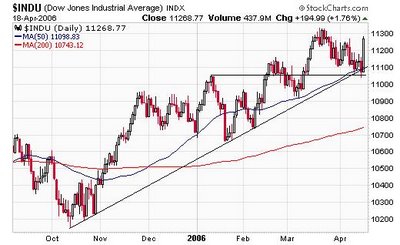
I added a blog with my mini-sized DOW future trades on this blog. The system has a stop with 30 points and a target of 50 points.
Dow Jones

I added a blog with my mini-sized DOW future trades on this blog. The system has a stop with 30 points and a target of 50 points.
Dow Jones
Selasa, 18 April 2006
EXPECTANCY AND ACCURACY
Expectancy is a very important aspect of trading. It is not valuated by traders very well and not treated in books very often. The concept expectancy is based on a typical size of a typical win compared to the size of a typical loss.
There is a natural human tendency to want the majority of attempts to result in success. In most cases, this is very good but is it the case in trading? If trading more positions we may think the more winning positions, the better. Is this really the best way to measure a trader's effectiveness?
Expectancy is about an average outcome for a trade. The formula is derived very easily if one takes into account that the outcome of a trade depends on the probability of an average win minus the probability of an average loss.
E = P(w)W - P(l)L
(1)
where:
E = expectancy
P(w)= probability of a loss
P(l)= probability of a win
L = average loss.
The probability of a win equals the amount of winners divided by total trades and off course P(w) + P(l) = 1.
By this you can see that a system's profability depends on the size of a win versus the size of a loss and even with a low probablity of a win the system can make money. Lets take an example. Suppose the average win is 10 points and the average loss is 5 points and the probability of a win is 40% than:
E = 0.4 x 10 - 0.6 x 5 = 1 which is positive so even with more losers than winners (6:4) the system makes money. An expectancy of 1 for a system giving 100 trades will result in 100x 1 = 100 points profit.
You could setup many scenario's with an expectancy being positive with varying average losses and winners.
This is the outcome of various articles about expectancy eg.
Van Tharp:
.... your trading system should have a positive expectancy and you should understand what that means. The natural bias that most people have is to go for high probability systems with high reliability. We all are given this bias that you need to be right. We're taught at school that 94 percent or better is an A and 70 or below is failure. Nothing below 70 is acceptable. Everyone is looking for high reliability entry systems, but its expectancy that is the key. And the real key to expectancy is how you get out of the markets not how you get in. How you take profits and how you get out of a bad position to protect your assets. The expectancy is really the amount you'll make on the average per dollar risked. If you have a methodology that makes you 50 cents or better per dollar risked, that's superb. Most people don't. That means if you risk $1,000 that you'll make on the average $500 for every trade - that's averaging winners and losers together.
But now that we have got the clue to expectancy we may not conclude that our natural tendancy to trade a system with more winning trades, a system with a better accuracy is not important at all. In fact it is and I don't agree with
others on this subject.
Let me write the formula for the expectancy in another way. We know
P(W) + P(l) = 1 so
P(l) = 1 - P(w)
E = (Pw)W -{1-P(w)}L
E = P(w)W + L{P(w)-1}
(2)
Now we may start to investigate the role of P(w), the probability of a winning trade. Formula (2) consists of two factors: P(w)W and L{P(w)-1}. The first is allways positive while the second is allways negative because P(w) is smaller than 1. You can see this by taking an example and you have to bear in mind that P(w) is allways a number between 0 (zero) and 1.
So the bigger P(w), the bigger the first factor P(w)W but also the smaller negative the second factor becomes and so the bigger the result which is E the expectancy. This is true for every trade system. It is allways good to have a good accuracy for a tradingsystem.
Let's proceed and let us assume the expectancy being zero eg. E = O. This means that in the long run you win as many money as you lose. In gambling this is known as a fair game. It is said such a game to have even odds. Most gambling games don't have even odds, but negative so you lose in these games.
E = 0, eg formula (2) becomes:
0 = P(w)W + L{P(w)-1}
P(w)W = - L {1-P(w)}
P(w)W = {1-P(w)}L
W/L = {1-P(w)}/P(w)
(3)
This formula describes for every probability of a win P(w) the relation between the average win and the average loss, so that the system in the long runs has an expectancy of zero, making no loss nor profit. Suppose the probability of a win is 30%, than W/L becomes 2.33 which means that the system to break even must have an average win that is 2.33 greater then the average loss.
To become profitable the system must produce either bigger profits or smaller losses. But you have to keep in mind that bigger profits or smaller losses may change the probability of a win. This makes finding a trading system sometimes so frustating because minimizing your losses or maximizing the size of your win may lead to more losses and so to a lower win probability P(w).
A good accuracy for a system is psychologically very attractive to trade and also a very good to thing work for but you have to keep in mind that the expectancy must be positive by looking at the ratio of your average win to the average loss. But this is in a way the old adagium of cutting your losses and maximizing your win's
Systemtrading
Expectancy
There is a natural human tendency to want the majority of attempts to result in success. In most cases, this is very good but is it the case in trading? If trading more positions we may think the more winning positions, the better. Is this really the best way to measure a trader's effectiveness?
Expectancy is about an average outcome for a trade. The formula is derived very easily if one takes into account that the outcome of a trade depends on the probability of an average win minus the probability of an average loss.
E = P(w)W - P(l)L
(1)
where:
E = expectancy
P(w)= probability of a loss
P(l)= probability of a win
W = average win
L = average loss.
The probability of a win equals the amount of winners divided by total trades and off course P(w) + P(l) = 1.
By this you can see that a system's profability depends on the size of a win versus the size of a loss and even with a low probablity of a win the system can make money. Lets take an example. Suppose the average win is 10 points and the average loss is 5 points and the probability of a win is 40% than:
E = 0.4 x 10 - 0.6 x 5 = 1 which is positive so even with more losers than winners (6:4) the system makes money. An expectancy of 1 for a system giving 100 trades will result in 100x 1 = 100 points profit.
You could setup many scenario's with an expectancy being positive with varying average losses and winners.
This is the outcome of various articles about expectancy eg.
Van Tharp:
.... your trading system should have a positive expectancy and you should understand what that means. The natural bias that most people have is to go for high probability systems with high reliability. We all are given this bias that you need to be right. We're taught at school that 94 percent or better is an A and 70 or below is failure. Nothing below 70 is acceptable. Everyone is looking for high reliability entry systems, but its expectancy that is the key. And the real key to expectancy is how you get out of the markets not how you get in. How you take profits and how you get out of a bad position to protect your assets. The expectancy is really the amount you'll make on the average per dollar risked. If you have a methodology that makes you 50 cents or better per dollar risked, that's superb. Most people don't. That means if you risk $1,000 that you'll make on the average $500 for every trade - that's averaging winners and losers together.
But now that we have got the clue to expectancy we may not conclude that our natural tendancy to trade a system with more winning trades, a system with a better accuracy is not important at all. In fact it is and I don't agree with
others on this subject.
Let me write the formula for the expectancy in another way. We know
P(W) + P(l) = 1 so
P(l) = 1 - P(w)
E = (Pw)W -{1-P(w)}L
E = P(w)W + L{P(w)-1}
(2)
Now we may start to investigate the role of P(w), the probability of a winning trade. Formula (2) consists of two factors: P(w)W and L{P(w)-1}. The first is allways positive while the second is allways negative because P(w) is smaller than 1. You can see this by taking an example and you have to bear in mind that P(w) is allways a number between 0 (zero) and 1.
So the bigger P(w), the bigger the first factor P(w)W but also the smaller negative the second factor becomes and so the bigger the result which is E the expectancy. This is true for every trade system. It is allways good to have a good accuracy for a tradingsystem.
Let's proceed and let us assume the expectancy being zero eg. E = O. This means that in the long run you win as many money as you lose. In gambling this is known as a fair game. It is said such a game to have even odds. Most gambling games don't have even odds, but negative so you lose in these games.
E = 0, eg formula (2) becomes:
0 = P(w)W + L{P(w)-1}
P(w)W = - L {1-P(w)}
P(w)W = {1-P(w)}L
W/L = {1-P(w)}/P(w)
(3)
This formula describes for every probability of a win P(w) the relation between the average win and the average loss, so that the system in the long runs has an expectancy of zero, making no loss nor profit. Suppose the probability of a win is 30%, than W/L becomes 2.33 which means that the system to break even must have an average win that is 2.33 greater then the average loss.
To become profitable the system must produce either bigger profits or smaller losses. But you have to keep in mind that bigger profits or smaller losses may change the probability of a win. This makes finding a trading system sometimes so frustating because minimizing your losses or maximizing the size of your win may lead to more losses and so to a lower win probability P(w).
A good accuracy for a system is psychologically very attractive to trade and also a very good to thing work for but you have to keep in mind that the expectancy must be positive by looking at the ratio of your average win to the average loss. But this is in a way the old adagium of cutting your losses and maximizing your win's
Systemtrading
Expectancy
Kamis, 13 April 2006
BIG DOW HOPELESS?
“Frankly, if you look at the number of exchange traded funds out there, you could wallpaper your hall with most of them, because they are not being used for anything else.”
Strange words especially if you consider who said this: they are from Robert Ray who is senior vice- president of business development at the CBOT, so the man also responsible for these numbers of traded products out there. CBOT offering the big DOW now, but still after two weeks volume still very low, only in the (lower) hunderds a day.
Of course the CBOT rivals CME for customers fiercely. The competition between exchanges is leading to strange products, such as european weather futures which seems to me to be more some kind of betting product, beyond other things as the extension of opening hours of the NYSE and others.
Here is an interesting discussion about the big DOW, some of them propose to eliminate the 10$ dollar DJIA future.
I think the bigger players won't get attracted so easily to the DOW. They trade the the ES and/or the big SP and why would they change? The DOW for them not being the benchmark of the US economy but the S@P is.
Dow Jones
BIG DOW future
Langganan:
Postingan (Atom)
