Filing bankruptcy is not only a last resort legal action; it is
also a very complicated legal action that definitely needs the
expertise of a lawyer. When thinking about bankruptcy, you
first need to decide if bankruptcy is right for you. If it is,
then you need the help of an attorney to decide which type of
bankruptcy is required for your particular situation.
The decision to file bankruptcy can be brought on by many
different circumstances. The most common circumstances are
divorce, medical hardships and credit card troubles. In cases
of divorce, bankruptcy is often inevitable. The sudden change
in financial level and the added burden of court costs, extra
expenses and child support often cause one or both parties to
get behind on their financial obligations.
In the case of medical hardships, high medical bills can
sometimes overburden people even if they have insurance. This
is even more likely to happen if the person experiencing the
medical emergency is also the family breadwinner.
The most common case of financial hardship is incredibly high
credit card balances. After carrying numerous high credit
balances for a certain period of time, many people find
themselves unable to make anything but the minimum payment and
sometimes not even being able to make that. Then, when the high
interest rates are added in, people find themselves in a
situation where repayment is often impossible.
Whether your situation arose from one of the above financial
problems or not, sometimes bankruptcy is the only answer to
your monetary problems. Once you have decided that bankruptcy
is the answer for you, you will need to enlist the services of
a lawyer to decide which type of bankruptcy to file and to help
you navigate the many complex bankruptcy laws and regulations.
There are four main types of bankruptcy, Chapter 7, Chapter 13,
Chapter 11 and Chapter 12. Chapter 7 is the most common form and
can be used by businesses and individuals. Chapter 13 is the
second most common form, but it limited to use by individuals
only.
In a Chapter 7 bankruptcy, a debtor's property is divided into
to categories, exempt and non-exempt. Exempt properties include
things that the debtor will be allowed to keep like their home
and automobile. In the case of exempt properties, the debtor is
allowed to keep them as long as he or she continues to pay for
them. If a person cannot continue to make payments, the owner
of the loan may repossess the property, even after a bankruptcy
has been finalized. Any non-exempt or unsecured property will be
sold to cover the debtor's financial obligations. Debts such as
credit card debts and medical bills can be written off with
this type of bankruptcy, but other debts like school loans and
taxes cannot be.
In Chapter 13 bankruptcy, the debtor is required to come up
with a way to repay his or her debts, but these debts usually
do not have to be repaid in full. In most cases, a creditor
will agree to take a small percentage of the owed debt as
opposed to losing all repayment all together. This form of
bankruptcy is preferable for those individuals that wish to
keep all of their possessions and just need a chance to catch
up on their financial obligations. It does not, however, excuse
a debtor from priority debts like taxes and child support.
In order to qualify for Chapter 13 bankruptcy, an individual
must have a yearly income level that allows for repayment of
each of his debts within three to five years. After three to
five years of consistent repayment, the debtor's obligations
are released.
After you have researched bankruptcy and decided that it is
right for you, you need to contact an attorney that specializes
in bankruptcy to help assure that you follow all legal
guidelines and are protected from further collection activity.
About The Author: Jody Ehrhardt write for
http://www.lawyervista.com, a website where you can find a
lawyer in your city or state, including
http://www.lawyervista.com/29-state-NV-nevada-bankruptcy_lawyer.html
Nevada bankruptcy lawyers and
http://www.lawyervista.com/29-state-UT-utah-bankruptcy_lawyer.html
Utah bankruptcy lawyers
Jumat, 17 Maret 2006
Rabu, 15 Maret 2006
CHANCE: GAMBLING LOVE AND MARKETS
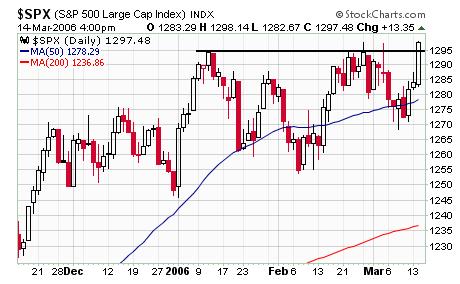
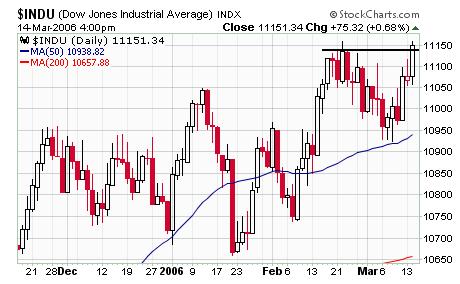
After days and weeks of moving inside a tradingrange the markets yesterday decided to go up closing near a few year's highs. Allthough the US markets hesitating the last weeks there was in fact no sign of hesitation on the European markets: they are up in a trend starting from november last year to all time highs recently.
Yesterday I found a book which tittle immediately decided me to order it: Chance: A Guide To Gambling, Love, The Stock Market, & Just About Everything Else. I will report about it when read and if as interesting as the tittle suggests. Probability being a subject to many fields including markets and science.


Dow Jones
Probability
Yesterday I found a book which tittle immediately decided me to order it: Chance: A Guide To Gambling, Love, The Stock Market, & Just About Everything Else. I will report about it when read and if as interesting as the tittle suggests. Probability being a subject to many fields including markets and science.
Dow Jones
Probability
Senin, 13 Maret 2006
PARDO AND SYSTEMTRADING
I read an interesting article from Robert Pardo: some quotes here without comments. It speaks for itself.
About optmization:
"A lot of people will say, “Let’s try some moving average idea, and optimize and see what we come up with.” They may optimize and find a few models that look really good and completely ignore the fact that most of the rest look pretty bad. I don’t consider optimization to be the way to find if a model is good."
About random trading:
"Think about it. If you buy or sell off the flip of a coin, and you know how to manage your risk and your profit, you should be able to make something. I have a former client who had determined, prior to starting with a system, that he would some make money even with a random trade selection. He called it a money management system—I’m not sure that’s what I would call it.
At any rate, you have to ask yourself why people lose so much money trading futures and stocks when by random selection, you should be able to get a fairly even mix of wins and losses. Most people don’t ask that question, but it’s a good question to ask."
About market characteristics and differences:
"Would you also like to see confirmation in other markets?
I’m a little bit different than a lot of people on that count.Let’s say somebody came to me and said “I’ve got a bunch of different models that trade a bunch of different markets, and they’re all different, but they’re all really great.” If I looked at the models and saw they were sound, it wouldn’t bother me a great deal that they wouldn’t work in other markets. Not as long as I felt they were sound in the market they were designed to trade. Individual market characteristics do exist."
About targets and profits:
"With the systems I’ve used over the years, targets have made the models perform less profitably. What you might find is, a model that trades a great deal and is highly accurate could be made more accurate by targets. If you’ve got a model trading 60 percent profitability and it’s a good model, the targets might add 5 to 10 percent to it. So then you’re right seven times out of ten, and for a lot of people, that’s a big difference. They really like being right that often. But that’s another reason people don’t trade well. They’re more interested in being right than they are in just making money."
About accuracy:
"I’ve never really cared about accuracy in a model. A lot of people do, and obviously,the more accurate the better, but I’ve never made that a primary focus in building a model. The models that my current platform started out with were in the area of 45 to 48 percent accurate. They still made a lot of money because they let profits run, and the losses were very manageable. It’s a great irony to me that with no effort to get accuracy, my current models are in the 60 to 65 percent accuracy range."
Systemtrading
Langganan:
Postingan (Atom)
